
Luxury retail digital signage and jewellery displays
In a luxury boutique, a screen should not be noticed — it should serve the piece, the gesture and the story. From the shopfront to the private room, every screen carries its own message, and all of them are managed from one dashboard.
The starting point
In a luxury boutique, the question is not the screen — it is what the screen does to the room
A jewellery house, a watchmaker or a leather goods brand has spent years building an interior. So the first question is never “what should we show?”, but “will it sit properly in the room?”
The journey
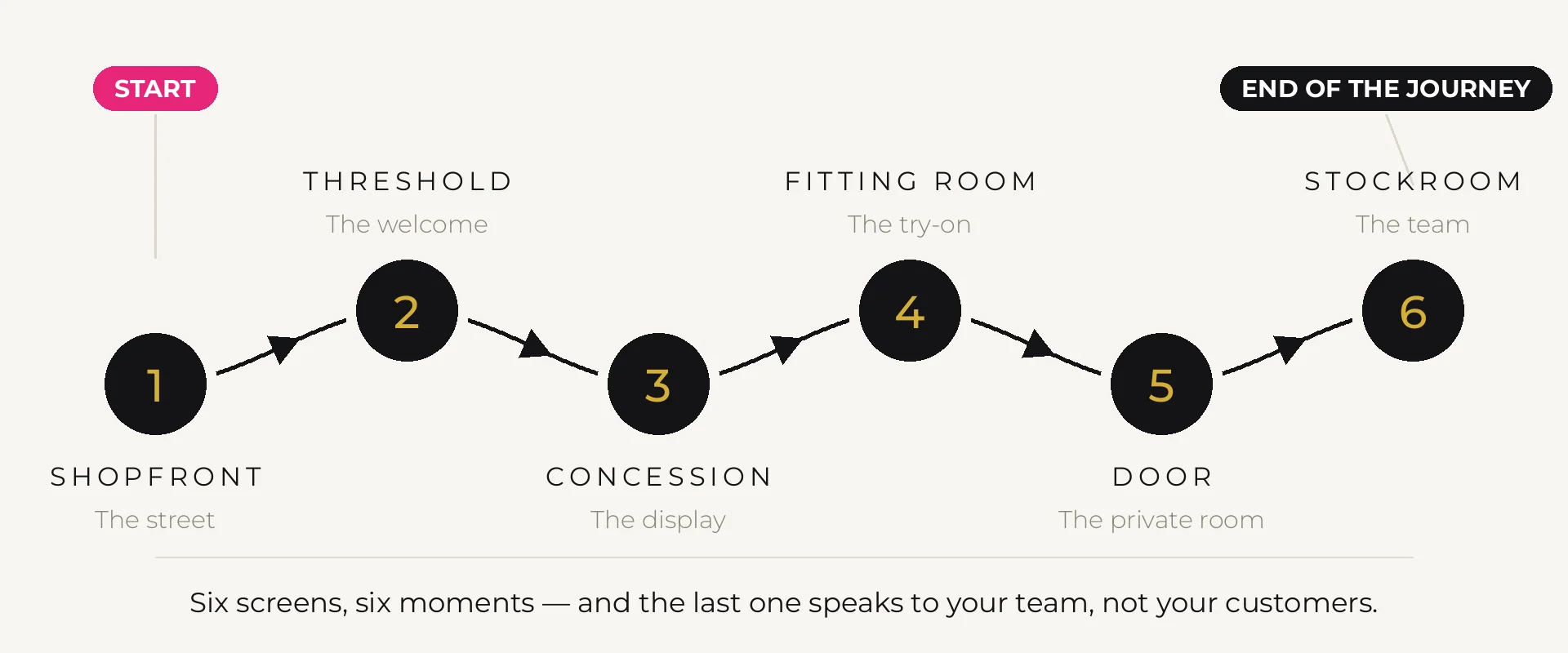
From the pavement to the private room, six moments worth equipping
Here is the route a customer takes through a luxury boutique, from the pavement to the stockroom. Each screen answers a different question, and the last one no longer speaks to the customer but to the team.


Fitting in
A screen you stop noticing
This is the condition every luxury house sets, and it is settled by details of installation and settings — not by the software.
Recessed, not hung
A recessed panel sits flush with the joinery: no bezel, no cable in sight. That is shopfitting work, and it belongs on the drawings.
Brightness comes down
A screen on the shop floor is not a window screen: brightness is set per location and per hour, so the piece itself stays the brightest thing in the room.
No banner, no logo
Content fills the whole panel, in the typefaces of the house. No software banner, no manufacturer logo, no standby message.
Switching off is part of the plan
Screens go dark at the hours when they would work against the room, and come back on by themselves. An e-paper panel stays readable without being lit at all.
The suite
Digital solutions for a luxury retail brand
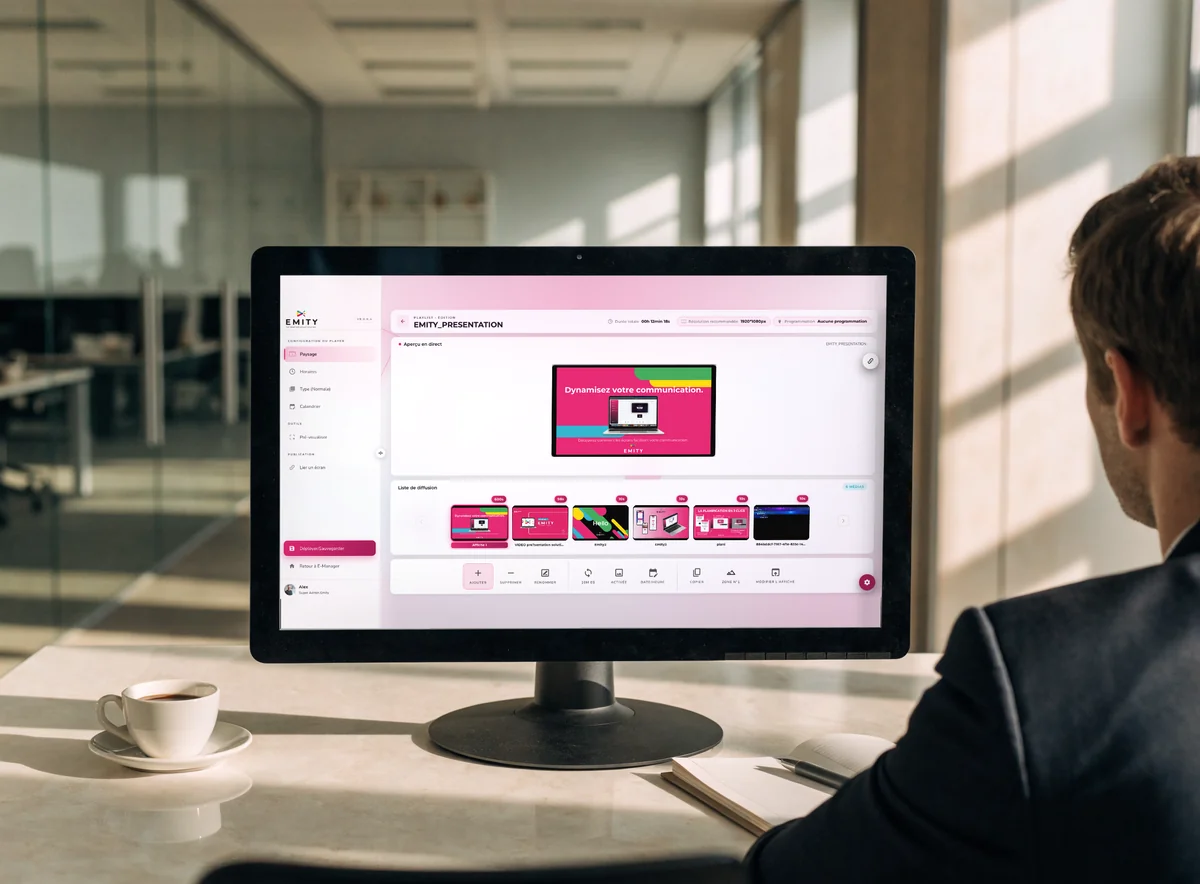
Six everyday jobs in a luxury boutique, one platform and one contract. Everything starts from E-MANAGER, the web dashboard that drives the screens, the kiosks, the private rooms and the visitors.
Visuals are put together in the built-in EMITY editor, from templates that carry the typefaces and colours of the house — and if your teams already work with them, Canva and Adobe Express connect to it as well. In-store music is managed from the same place.
Brand consistency
Approval, locked templates and launches timed to the second
Nothing reaches a screen without passing the brand team
In a luxury house, an unapproved visual appearing in a boutique costs more than a failed campaign. Three settings close that door.
- ✓Per-user rights separate the person who composes, the person who approves and the person who publishes. A boutique can prepare without being able to go live.
- ✓Locked templates fix the typefaces, the margins and the position of the logo: a boutique cannot “improve” the brand guidelines.
- ✓An end date is set alongside the start date: a campaign disappears everywhere at the second planned, neither before nor after.
- ✓The history keeps a record of what was shown, where, and by whom.
The estate
One brand, its flagships, its concessions and its franchisees
A luxury retail estate mixes statuses: owned boutiques, department store concessions, authorised stockists. Each one needs different rights over the same content.
Brand content
Composed at head office, pushed to a group of screens, identical everywhere. Nobody in a boutique can alter it.
Local content
A boutique event, unusual opening hours, a craftsperson visiting: the boutique publishes, in a slot reserved for it.
Concessions and franchisees
A narrower scope: access to approved visuals, with no right to compose. Consistency no longer rests on everyone’s goodwill.
Remote monitoring
A screen that drops offline, or a panel left black, shows up in the dashboard. Head office sees it before the boutique rings.
One account holds anything from one screen to a thousand: publishing to forty boutiques takes the same gesture as publishing to one. For retail estates wider than luxury, see also digital signage for shops.
The hardware
Which screen belongs where in the boutique
In luxury retail the choice comes down to the light in the room and the reading distance, never to the largest diagonal available.
| Location | Equipment | What decides |
|---|---|---|
| Shopfront | High-brightness screen facing the street | Direct sunlight: below 2,500 cd/m² the image disappears behind the reflection. Detail on the digital window display. |
| Concession, display wall | Recessed professional panel | Sitting flush: the shopfitting decides this, not the screen. See screens. |
| Fitting room, private room | Discreet panel or e-paper | The eye line: seated, the reading distance drops to two metres, so a small panel is enough. |
| Door, display stand, wayfinding | Battery-powered e-paper panel | Power and glare: with no socket and no shine, electronic ink is the only answer. |
| Large wall, seamless look | Fine pitch LED | Size: beyond 100 inches, LED avoids the seam between panels. Check compatibility: supported equipment. |
Before you choose
Five criteria that matter in luxury retail, and nowhere else
A signage platform is not compared on the same points from one sector to the next. Here is what makes the difference for a jewellery house, a watchmaker or a perfumery.
| Criterion | The question to ask | What EMITY answers |
|---|---|---|
| Visual neutrality | Does the software leave any mark on screen? | No: no banner, no logo, no standby message. |
| Locked templates | Can a boutique change the brand guidelines? | No: typefaces, margins and logo are fixed in the template. |
| Simultaneity | Can a launch go live everywhere at the same second? | Yes: scheduling by group, with time zones handled. |
| Electronic ink | Is there a matte option, cable-free and glare-free? | Yes: e-paper, which EMITY was the first French software company to support. |
| Network isolation | Does the player have to join the brand’s own network? | No: a separate internet link, outbound only. |
Getting started
Four steps, and the first boutique is on air
A connection, not an integration
A dedicated internet link is enough, outbound only. No connection to the brand’s own network, so no case to put to IT.
The panel, fitted with the shopfitter
This is where the result is decided: recessing, orientation, brightness settings. An E-BOX behind the panel, or E-SOFT installed inside it.
The templates of the house
The built-in editor starts from the typefaces and colours already in use. Those templates, locked, are what the boutiques will work with.
The groups, once and for all
Shopfronts, concessions, private rooms, stockrooms: groups are created once. After that, a global launch costs three clicks.
EMITY sells through a network of certified resellers: installation and training are handled by a partner near you, in France and across Europe.
The scale
EMITY in a few figures
+7,000
connected screens
+1,000
customer accounts
+130
distribution partners
+20
countries
EMITY is a French software company, founded in 2018 in Montpellier. One account holds anything from one screen to a thousand, which leaves room for a single luxury boutique as much as for an international estate. The detail of the plans: our offers and our subscriptions.
Frequently asked questions
What luxury retail brands ask before they equip
Nearby
Three pages that complete this one
The window screen, in detail
Brightness, formats and fitting for window equipment: the digital window display.


