Manufacturing · Construction · Logistics

Industrial digital signage: the right instruction at every workstation

On a factory floor or a construction site, a notice pinned to the wall is out of date within days and a printed rota is stale before the week is out. Screens connected to one platform carry the same information at the gatehouse, in the changing room, on the shop floor and at the loading bay — and you change it in minutes, across every site at once.

7,000+screens connected
1,000+customer accounts
20+countries

The problem

Why paper cannot keep up with an industrial site

On a production site or a construction project, the information changes daily: an area is closed off, a delivery slot moves, a safety instruction is revised. The medium does not move at all.

Printed notices go stale

Pinned up in the mess room, a notice is read once and then ignored. Nobody is sure whether it is current, and reprinting it takes longer than writing it did.

The message never reaches the workstation

It leaves head office or the site office, then stops at the canteen noticeboard. On the shop floor, at the bay, in the changing room, it never arrives at the same moment.

Instructions are repeated by word of mouth

Reminding people of the PPE required, the emergency numbers or today’s restricted area takes up a supervisor’s morning, and depends on what they remember.

The people on site keep changing

Agency staff, subcontractors, hauliers, visitors: some of the people on your site are seeing it for the first time that day, with no history of your instructions.

The journey

From the gatehouse to the site office: six moments worth a screen

Here is a day on an equipped site, followed as the people who walk into it experience it: a driver signing in, an agency worker starting a shift, a site manager checking three projects. At each point the screen answers a different question — and all of them run from the same dashboard.
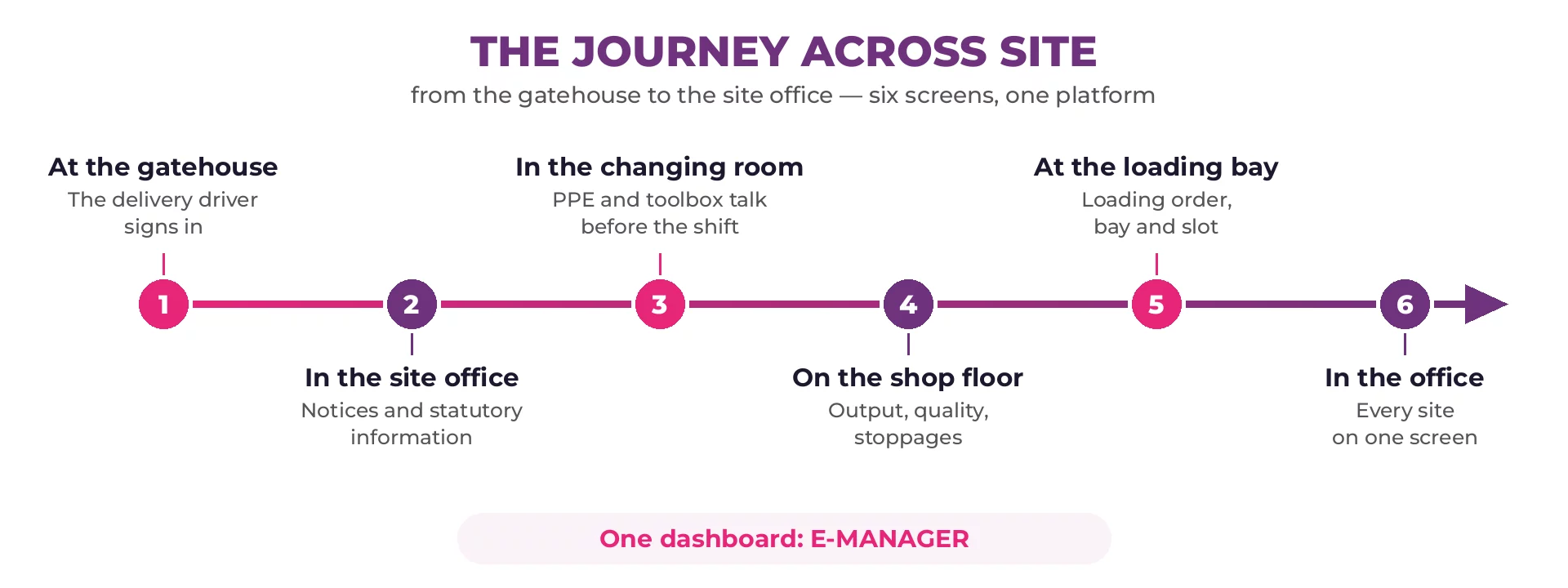
Six-step journey across an industrial site: gatehouse, site office, changing room, shop floor, loading bay and site office

Contractor in a hi-vis vest signing in at an access terminal at the entrance to an industrial site

1 · At the gatehouse

A haulier or a subcontractor arrives at the entrance. The screen shows the access procedure and the PPE required; the visitor and staff register records their arrival, so the list of everyone on site is available the moment you need it at the muster point.

Signing in

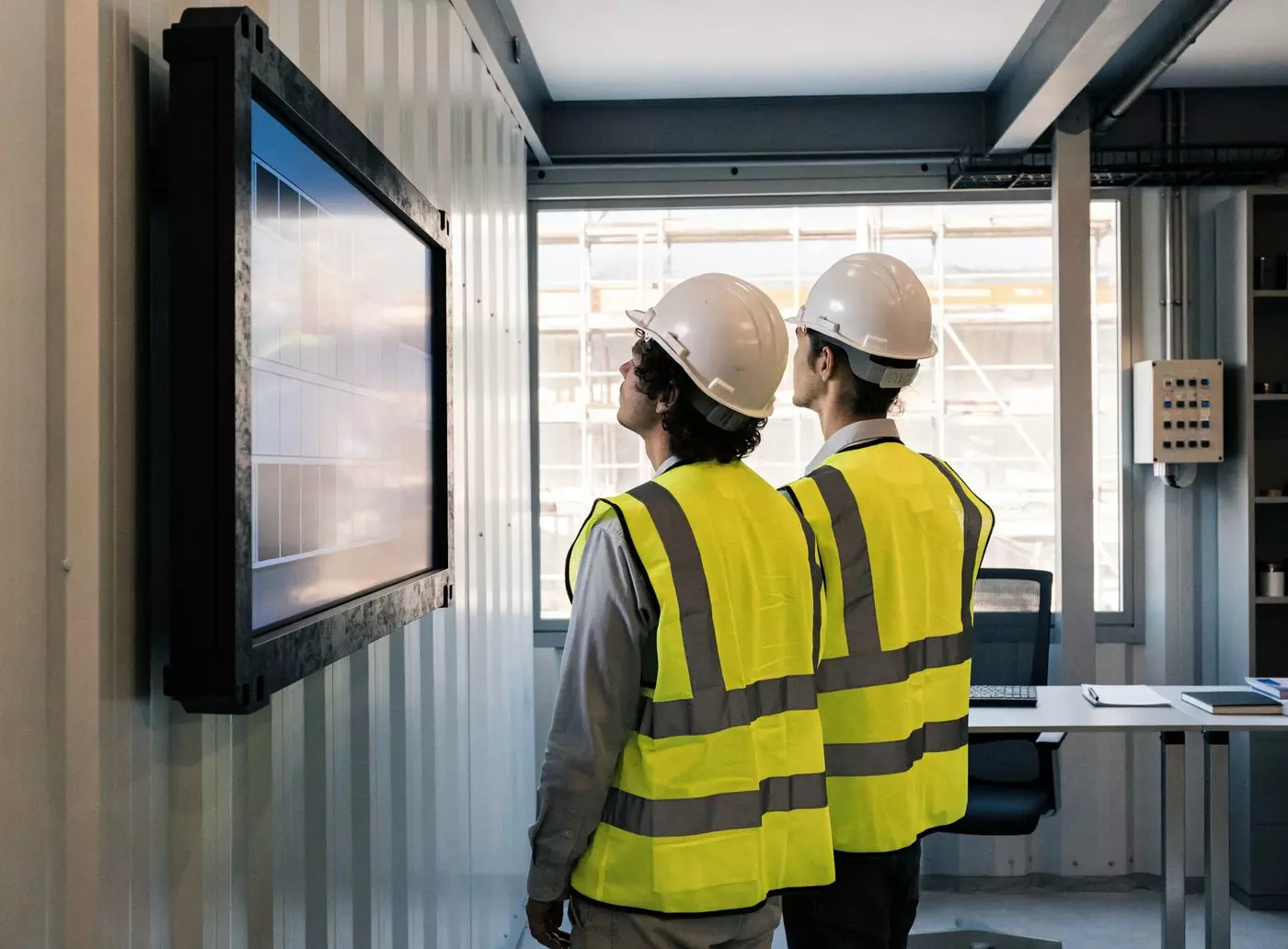
Screen showing statutory notices in the site office of a construction project, two workers in front of it

2 · In the site office

Everyone passes through it. One screen gathers what used to be scattered across the walls: today’s instructions, weather and stoppages, progress on the works, and the notices you are required to display — which is what the statutory display module is for.

Informing

Operator in a work jacket in front of a screen showing the day’s toolbox talk in a factory changing room

3 · In the changing room

Right before the shift starts, when the instruction matters most: PPE required, the time of the toolbox talk, today’s restricted area. You change the message the evening before from a desk, rather than walking out to put up a poster.

Preventing

Industrial screen showing production figures on a factory shop floor

4 · On the shop floor

In the production area the screen becomes a performance display: line output, target for the shift, reject rate, current stoppage. The figures come from the systems you already run, through dashboard widgets, with no re-keying.

Running

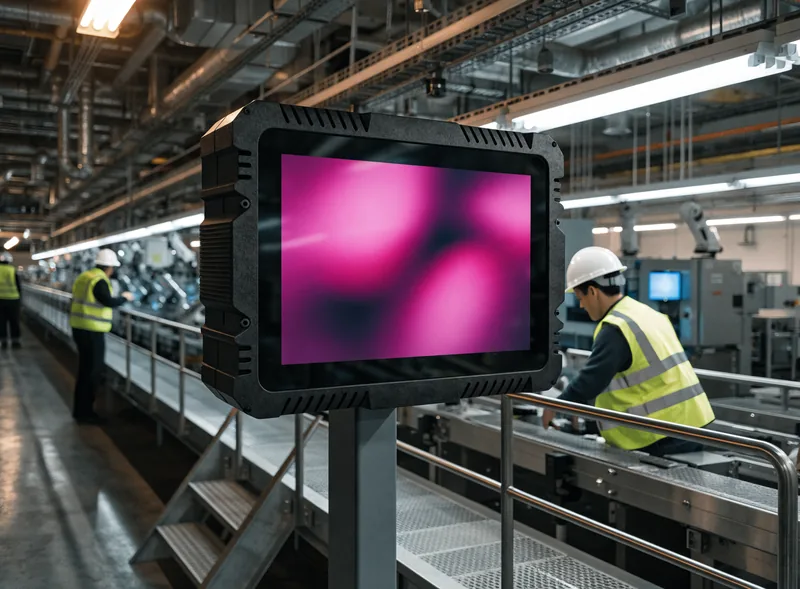
EMITY screen installed alongside the conveyors of a logistics hub

5 · At the loading bay

The driver can see which bay to pull up to, in what order and for which slot. That is what E-DOCK does: bay and hub signage, run from the same platform as every other screen on site.

Ordering

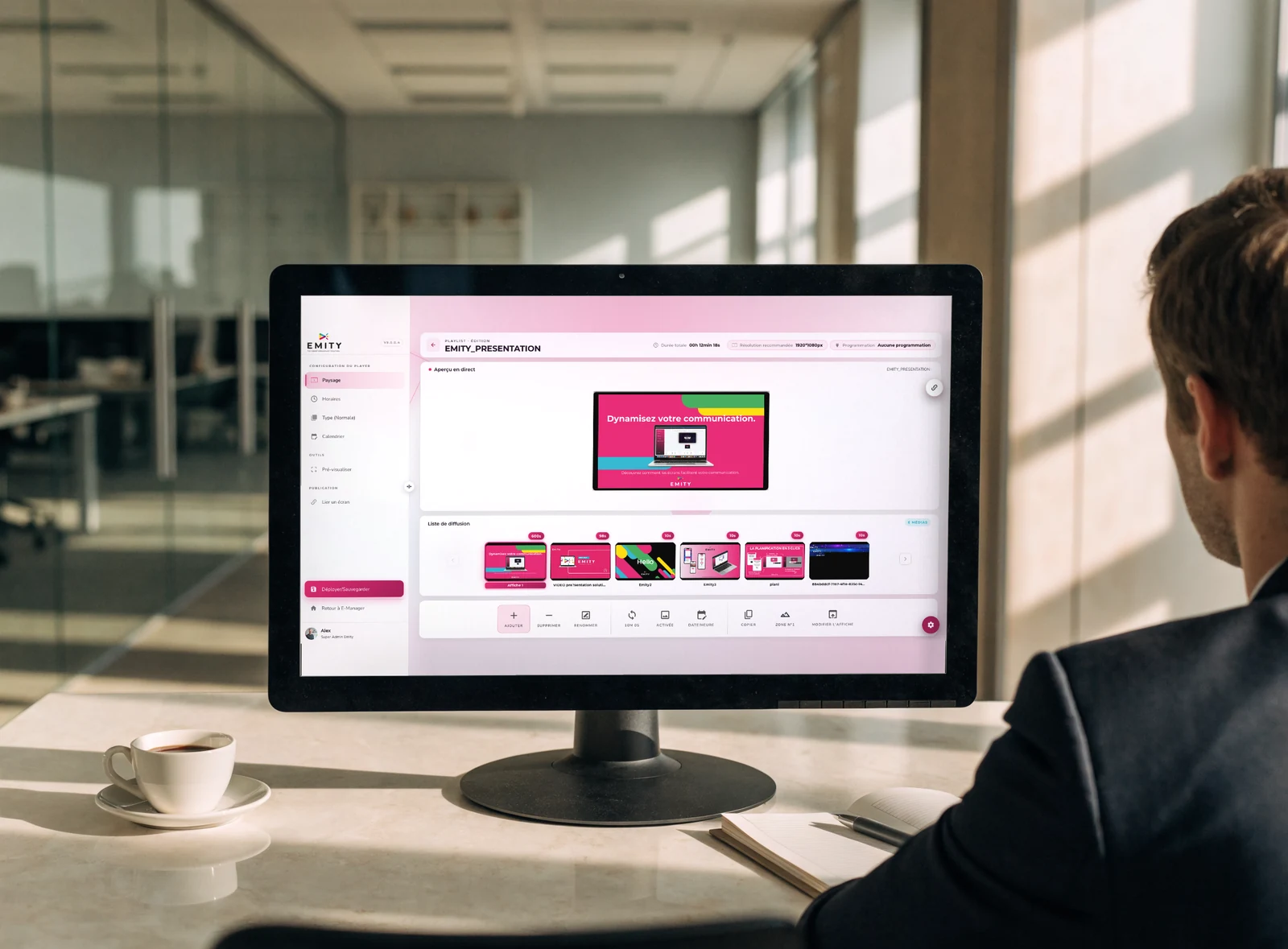
Managing a fleet of screens from the E-MANAGER platform on a desktop monitor

6 · In the office

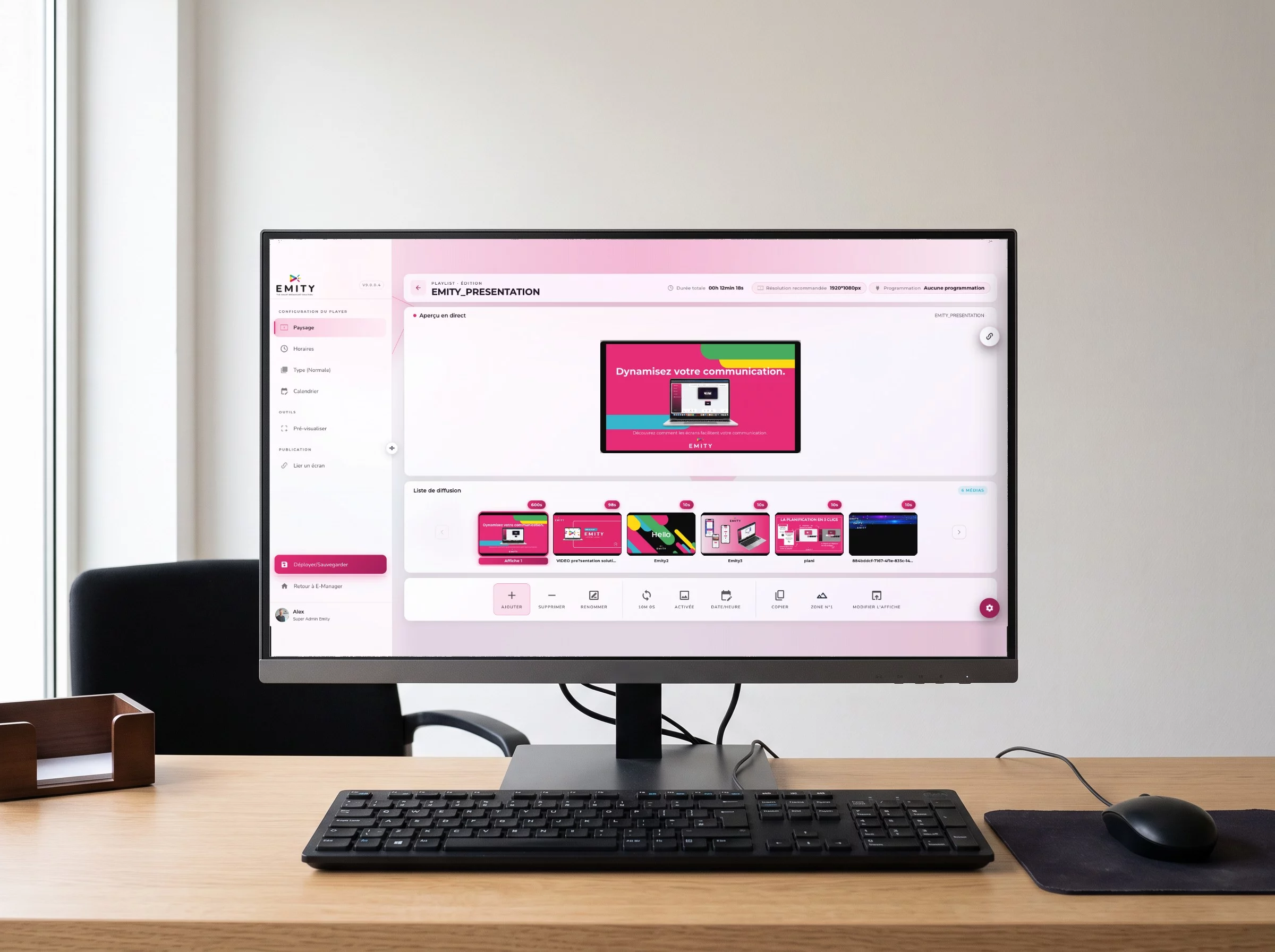
This is the only screen that is not aimed at the people on the ground. From E-MANAGER a site manager sees the state of every screen across every site, corrects a message and checks that it has gone out — including on a project 200 miles away.

Overseeing

The six screens do not arrive on the same day: most sites start with the site office or the changing room, then add workstations as the need comes up. The platform is the same from the first screen to the hundredth.

The proof

Industrial, construction and logistics groups already equipped

The video below was filmed at one of the most recent GLS logistics hubs: screens installed along the conveyors, run from E-MANAGER.

The content

What your screens actually show

Three families of message cover most of what an industrial site or a construction project needs. They share the same screen, in rotation.

Safety and prevention

  • PPE required, area by area
  • Emergency numbers and evacuation routes
  • Weather warnings and restricted areas
  • Toolbox talks and safety reminders
  • The notices you are required to display

Production and quality

  • Line output and target for the shift
  • Performance figures and reject rates
  • Stoppages and downtime in progress
  • Shift rotas and handovers
  • Delivery slots and loading bay order

Site life and people

  • Progress on the works, site photographs
  • Starters, leavers, vacancies
  • HR announcements and staff notices
  • Canteen menu, day-to-day site news
  • Messages from head office to every site

On the ground

A factory floor is not an office

This is where most signage projects come unstuck: the place you need to equip has neither the light, nor the cleanliness, nor sometimes the power supply of a head-office corridor.

Dust, knocks and temperature

Screens built for industrial use come with protective glass and a wider temperature range. We point you towards the hardware that suits the area, rather than a consumer television.

Direct sunlight and outdoor sites

Under a roof light, on a yard or at a depot entrance, an ordinary screen is hard to read. High-brightness panels and weatherproof totems settle the question — see the compatible equipment list.

A point with no power supply

A site office that moves, an isolated gate, area signage: electronic paper (e-paper) draws no power while the image stays the same, runs for up to five years on battery and stays readable in full sun.

A patchy network

The E-BOX player downloads the content and then plays it locally: losing the network does not blank the screen, it carries on with the last schedule it received.

Screens you already own

EMITY works with every manufacturer. A fleet installed by another vendor can be taken over: either with an E-BOX, or with E-SOFT, the app embedded on professional screens running Android, Tizen (Samsung) and webOS (LG).

A video wall in reception

Master-slave synchronisation drives several panels as a single image, with no lag — useful for a reception area or a control room.

Several sites, several projects, one dashboard

A construction business opens and closes projects constantly; a manufacturer spreads its teams across several buildings, sometimes several countries. So the question is not only how to display something, it is how not to have to do it site by site.

  • Screen groups: one message goes to “all changing rooms” or “the northern sites” in a single action.
  • A shared base with local exceptions: the group-wide safety notice shows everywhere, while each site keeps its own rota.
  • Permissions per user: head office publishes safety, the site manager handles their own project and nothing else.
  • The state of the fleet, live: you can see which screen is on, which player received the schedule, and which one has stopped answering.
  • From 1 to 1,000 screens per account: the platform does not change as the fleet grows.
OUR REFERENCIES


AirbusEDFRenaultSNCFSchindlerSchlumbergerSGSApaveGroupe VilogiaVidelioGLSCereg

How it works

How a screen starts showing your instructions

Four steps, and no IT skills needed. Getting the first screen live usually takes less than half a day.

1

You build the content

In EMITY’s built-in editor you put together an instruction or a rota from a template, straight inside the platform — nothing to install. If your teams already use Canva or Adobe Express, both connect as well.

2

You schedule it

You choose where and when: that screen, that group of changing rooms, 6am to 2pm, Monday to Friday. A weather warning can jump ahead of everything else without touching the usual schedule.

3

The screen plays it

An E-BOX player plugs in behind the screen, or E-SOFT installs directly on screens running Android, Tizen or webOS. Playback is local, so it carries on even if the network drops.

4

You check it

E-MANAGER shows the state of every screen and what it is playing. You know the instruction arrived without ringing the site.

EMITY is sold through a network of certified resellers, so your usual installer can carry the project from choosing the screens to mounting them. You can also read more about the digital signage platform itself.

Frequently asked questions

What manufacturers and construction firms ask before they commit

Industrial digital signage means showing information on screens connected to a single platform, in place of paper notices and noticeboards. In a factory or on a construction site those screens carry three families of content: safety (PPE required, emergency numbers, restricted areas), production (output, targets, stoppages, delivery slots) and site life (rotas, progress on the works, staff announcements). A message is changed from one workstation and reaches every screen concerned within minutes.

EMITY is a French software publisher, based in Montpellier since 2018, with more than 7,000 screens connected across more than 20 countries. Three things matter particularly on an industrial site: compatibility with every screen manufacturer, so an existing fleet can be taken over; a multi-purpose suite in which signage, the visitor register and loading bay signage share one platform; and support for electronic paper, for points with no power supply. Sales run through a network of more than 130 certified resellers.

Yes. Screens are arranged in groups — by site, by building, by type of workstation — and a publication targets a whole group rather than one screen at a time. A safety instruction sent from head office therefore goes to “all changing rooms” or “all northern sites” in a single action, while each site keeps control of its own rota. Permissions per user decide who can publish what, and where.

In most cases, yes. EMITY works with every manufacturer: either by plugging an E-BOX player in behind the existing screen, or by installing the E-SOFT app directly on professional screens running Android, Tizen (Samsung) or webOS (LG). A fleet set up by another vendor can therefore be taken over without replacing the hardware. The list of verified devices is published on our compatible equipment page.

The documents an employer has to make available to staff can be gathered onto one screen in the site office rather than pinned up separately. There are two benefits: the update is made once for every site, and you know what is on display at any given moment. Note that display obligations vary with the size of the business and the nature of the works, so check your own situation with your health-and-safety adviser before taking any paper notice down.

That is what electronic paper, or e-paper, is for. An e-paper panel only draws power when the image changes, so it runs for up to five years on battery with no wiring. It is matt, readable in full sunlight, and updated remotely like any other screen. EMITY is the first French publisher to support the technology, which suits a site office that moves, an isolated gate or area signage.

The screen keeps playing. The E-BOX player downloads content and then plays it locally, so playback does not depend on the connection — only updates wait for the network to come back. On an industrial site where coverage is uneven, that is what prevents a black screen, which on a safety display reads as a fault.

The entry and exit register records the arrivals and departures of visitors, subcontractors and hauliers, from a kiosk or a tablet at the gatehouse. The list of people on site can be consulted at any time, including from a phone at the muster point. It is a module of the same platform as the screens: one account, one thing to learn.

Getting the first screen live usually takes less than half a day: create the account, build a first piece of content in the built-in editor, plug in the player. The real timescale of a project depends mostly on hardware — choosing screens suited to each area, getting them delivered and mounted, usually by a certified reseller. A three-month trial lets you test the platform on one screen before committing the rest of the fleet.

Nearby

Four pages that go with this one

The visitor register

Recording entries and exits at the gatehouse: visitor register.

Loading bay signage

Loading order, bays and slots with E-DOCK.

Statutory display

The notices intended for staff, without reprinting: statutory display management.

Kiosks and interactivity

Looking up a plan or a procedure on an interactive kiosk, and triggering content with an NFC tag.

Putting it into practice

Let us look at what your screens would show

Tell us where your display points are today — site office, changing room, shop floor, loading bay — and we will show you how it would look on your own organisation. The three-month trial is free and there is no commitment.