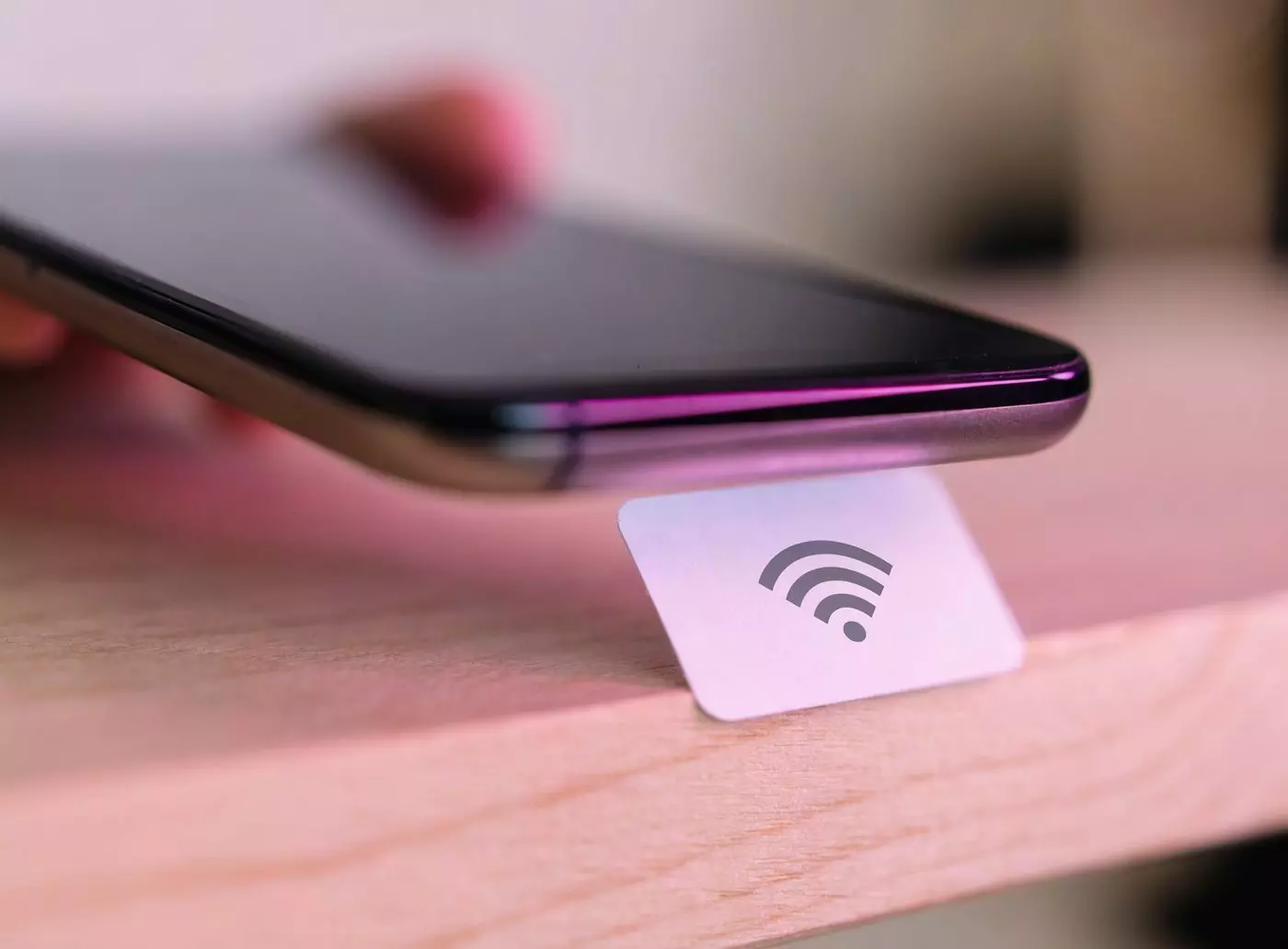
NFC INTERACTION

NFC interaction and digital signage: trigger the right content at the right time

Almost all smartphones today are equipped with NFC technology. Every visitor already carries the remote control for your screens in their pocket. With E-MANAGER, NFC interaction applied to digital signage automatically triggers the right visual content when a customer makes physical contact with a product, a kiosk, or a device.

94% NFC-equipped smartphones
×12 Engagement vs. QR code
<2s Trigger time
NFC Tag NFC Playlist active - E-MANAGER
NFC TECHNOLOGY

NFC technology in the service of digital signage

The principle of Near Field Communication (NFC)

Near Field Communication (NFC) is a wireless technology that operates over a range of less than 4 centimeters. This protocol allows for information exchange between two compatible devices without prior pairing. Unlike Bluetooth or Wi-Fi, the connection is made through simple physical proximity. This characteristic makes NFC particularly suitable for fast interactions at the point of sale, in offices, agencies, or reception areas—where a single gesture is enough to trigger the right information on the nearest screen.

Range < 4 cm
Near-physical contact
No pairing required
Instant connection
Managed by E-MANAGER
Remotely configurable scenarios
Reader mode
Passive tag reading
Card emulation mode
Contactless payment
Peer-to-peer mode
Device-to-device exchange

The three operating modes of an NFC tag

An NFC device operates according to three distinct modes:

1. Reader mode: the smartphone reads data stored on a passive NFC tag (a label or NFC chip attached to an object). This is the mode used in digital signage to trigger content on a screen.

2. Card emulation mode: the phone behaves like a contactless card, used for contactless payment via applications like Apple Pay or Google Wallet.

3. Peer-to-peer mode: two NFC devices exchange data with each other, useful for quick information sharing. This mode is used, for example, for NFC on phones between colleagues.

From smartphone to tag: how NFC triggers content on screen

The trigger flow is simple. A visitor brings their smartphone close to an NFC tag placed on a product, kiosk, or furniture. The tag transmits an identifier to E-MANAGER, which identifies the associated scenario and instantly pushes the corresponding media to the targeted screen: video, image, or interactive page. The entire process takes less than two seconds and requires no further action from the visitor.

1. NFC tag scanned
Smartphone/tag contact
2. Signal transmitted
Identifier sent to software
3. Content displayed
Media in <2 seconds
BENEFITS

Why choose NFC for your digital signage screens?

Instant triggering without downloading an app

NFC requires no prior download. The visitor brings their phone close to the tag and the content is displayed on the screen in less than two seconds via E-MANAGER. Consumers are up to 12 times more likely to interact with an NFC tag than with a QR code on a shelf (ROI Advisers). This fluidity eliminates the friction that hinders digital interactions in-store: opening an app, scanning a code, and waiting for it to load.

Personalized experience based on visitor context

Each NFC beacon can be associated with different content. The same interactive screen will display a technical sheet if the visitor touches the tag for product A and a demonstration video for product B. This personalization of the customer journey is programmed without technical intervention on-site. Interactivity changes according to the scanned tag, the time slot, or the event playlist profile. Your new scenarios are deployed remotely, from an office or agency, without on-site manipulation.

Measurable and traceable engagement

Every NFC interaction generates actionable data: scan time, triggered tag, displayed content, and viewing duration. These new metrics directly feed your marketing strategy at the point of sale and provide a catalog of useful indicators to improve the customer experience.

Enhanced security through short-range NFC

The range of NFC is limited to 4 centimeters. This distance makes any attempt at interception or unauthorized reading practically impossible. Unlike Bluetooth (10-meter range) or Wi-Fi, NFC requires near-physical contact. It is the visitor who voluntarily decides to trigger the interaction—no passive capture is possible.

Did you know?

Digital signage made interactive by NFC changes the visitor’s relationship with the screen: they no longer consume passively, they choose what they want to see. This is exactly what the E-MANAGER NFC module allows, without any application to install.

NFC, QR code, or Bluetooth: a comparison to help you choose your interaction technology

Three technologies compete for triggering content on screens. The choice depends on your context.

Comparison of interaction technologies

NFC vs. QR Code vs. Bluetooth LE for digital signage

Criterion NFC QR Code Bluetooth LE
Trigger speed < 2 s 5 - 10 seconds
(scan + loading)
Variable
(pairing required)
App required No Yes (camera) Yes (dedicated app)
Range < 4 cm Unlimited (visual) Up to 10 m
Cost per tag €0.10 - €0.50 Free
(printing)
€5 - €15 (beacon)
Engagement rate x12 vs. QR
(ROI Advisers)
Reference Low
(app friction)
Security High
(physical contact)
Medium
(spoofable)
Medium
(extended range)

NFC takes the lead in retail and showrooms thanks to its speed and superior engagement rate (×12 vs. QR code on shelves). QR codes remain relevant for printed materials or distances greater than 4 cm. Bluetooth Low Energy is suitable for indoor navigation scenarios. For digital signage driven by visitor action, NFC offers the best interactivity/engagement ratio. New projects are combining these three technologies according to the application area and the brand’s sales objectives.

USE CASES

Concrete use cases for NFC interaction in digital signage

NFC Interactions by Industry Sector

5 Real-World Use Cases of NFC-Driven Digital Signage

🛒
Retail
1
Product Touched
2
NFC Tag Scanned
3
Demo Video on Screen
🏢
Corporate
1
Badge Presented
2
Tag Read
3
Presentation Displayed
🏛️
Culture
1
Artwork Approached
2
Tag Scanned
3
Enriched Content on Screen
🏪
Retail
1
Aisle Visited
2
Tag Activated
3
Promotion Displayed + Queue Managed
🗺️
Tourism
1
Kiosk Touched
2
Tag Read
3
Real-Time Local Information

Retail: Trigger a Product Video In-Store

A customer selects an item on the shelf. An NFC tag integrated into the label or display triggers a demonstration video on the nearest screen, controlled by E-MANAGER. In the automotive sector, for example, the same logic allows a test drive video or technical catalog to launch when the visitor touches the nameplate of the displayed vehicle. Interactivity transforms the shopping experience in retail.

Product Video In-Store
Automatic Triggering on Contact
Interactive Demo
Automatic Display on Screen
×12 Engagement vs. QR Code
Source: ROI Advisers
In-Room Presentation
Badge or Smartphone
Interactive Showroom
Dedicated Content per Product

Corporate: Launch On-Demand Content in Showrooms or Meeting Rooms

In professional environments, NFC transforms a simple gesture into a presentation tool. An employee brings their badge or smartphone near a tag fixed to the meeting table and the content of their presentation immediately displays on the room’s screen. During a site visit, several tags distributed throughout the premises automatically trigger the right presentation at each stage of the tour—production, R&D, showroom, offices. In showrooms or smart office environments, each displayed product can be associated with dedicated interactive content. All controlled from E-MANAGER, without on-site manipulation.

Culture and Museums

Museums and cultural venues use NFC tags to enrich the customer journey without additional equipment. A visitor brings their phone near an artwork and accesses an audio commentary, a video of the creation process, or documentary content on the adjacent screen. The system works without a dedicated application and adapts to multiple languages based on the mobile phone settings. This digital interactivity opens new visit opportunities for French and international clientele.

Retail: In-Store Promotions

In large retail stores, a tag positioned near a product triggers a promotional offer on the aisle screen, controlled from E-MANAGER. You adapt the promotion according to time slot, aisle, or product category, without physically returning to the stores.

Retail: Queue Management

At checkout or reception, NFC integrates with E-CLICK for contactless queue management: ticket retrieval by bringing the phone near, calling customers when their turn arrives, average wait time displayed on screen.

Tourism and Local Authorities

Tourist offices and local authorities deploy kiosks equipped with NFC tags to broadcast practical information in real time: transport schedules, local events, interactive maps. Visitors access the content of their choice with a simple gesture. NFC complements the interactive kiosk by adding a layer of personalization according to the visitor’s interest. Local authorities in France increasingly use these interactive advertisements with animated visual content to enhance tourist reception.

Key Statistic

In France, 70% of consumers notice digital signage screens and 80% state they are attracted to stores by these screens (IFOP / Club du Digital Media, 2025).


DEPLOYMENT

Deploy NFC Interaction on Your Screens: Security and Best Practices

Native Security

  • Range limited to 4 cm—intrinsic security mechanism
  • No remote interception possible
  • Voluntary visitor contact required

GDPR compliance

  • NFC Tags: No Personal Data Collected
  • Interaction metadata to be anonymized
  • Clear signage to inform visitors

NFC Tag Selection

  • NTAG213 for simple identifier (basic scenarios)
  • NTAG216 to store more data per tag
  • Universal smartphone/tablet compatibility
  • Durable tags for demanding environments

Positioning and Content

  • Tags at eye or hand level
  • Standardized NFC pictogram visible
  • Short videos (15-30 seconds)
  • Loading time < 2 seconds
  • Fallback content (static image) in case of latency
Expert AdviceNFC tags themselves do not collect any personal data. It is the digital signage software that can record interaction metadata (number of scans, times, displayed content). Ensure you anonymize this data and inform your visitors via clear signage.

EMITY SOLUTION

How Does EMITY Integrate NFC into Its Digital Signage Suite?

Event Playlist

EMITY offers a native event playlist feature in E-MANAGER. This playlist directly integrates the NFC tags used in the field. A specific media item (image, video, or animated sequence) is configured to display during the selected interaction. You can program several different NFC scenarios on the same screen, with each tag triggering its own content.

E-MANAGER Configuration

Configuration is performed from the E-MANAGER web interface. The process is simple: associate an NFC tag with a media item in the library, define triggering conditions (schedule, priority), and activate the scenario. Centralized management allows you to control dozens of tags distributed across multiple sites from a single dashboard. No technical expertise is required.

Automatic Return

After the NFC-triggered content is broadcast, the screen automatically returns to its regular programming (standard playlists or standby playlist). No manual intervention is necessary. This function ensures that your screens never remain stuck on temporary content and continue to broadcast your standard programming.

Find Your Ideal NFC Scenario with EMITY

Each sector has its own needs regarding NFC interaction. Whether you are in retail, corporate, culture, or local authorities, EMITY adapts the solution to your context.

Configurateur NFC - Affichage dynamique

Trouvez le scénario NFC adapté à votre secteur en 2 clics

1
Votre secteur
2
Type d'interaction NFC
Recommandation personnalisée

Déploiement pilote via la playlist événement E-MANAGER en moins de 48 h.

Demandez une démo gratuite
FREQUENTLY ASKED QUESTIONS

FAQ—NFC Interaction and Digital Signage

What Is Digital Signage Management?

Digital signage refers to the broadcast of visual content (videos, images, animations) on connected screens. A SaaS software like E-MANAGER allows you to create, schedule, and control this content remotely across a multi-site screen network.

How Does NFC Technology Work?

NFC technology (Near Field Communication) is based on near-field communication. Two devices exchange data when positioned less than 4 centimeters from each other. Triggering is instantaneous and requires no application download.

What Are the Applications of NFC in Digital Signage?

NFC triggers product videos in-store, presentations in showrooms, tourist information on kiosks, or enriched content in museums. It also integrates with contactless queue management to call visitors without manual intervention.

How Can You Improve Customer Interaction with NFC?

Script your content according to context: one tag per product, one tag per room, one tag per service. Customize the displayed media according to time slot. Measure the number of interactions to adjust your interactive content strategy and identify the most consulted products or areas.

Should You Enable or Disable NFC Technology?

NFC consumes very little power in standby mode. Enabling it allows you to take advantage of all contactless interactions: mobile payment, content access, identification. The 4 cm range makes the risk of unauthorized reading virtually zero.

Is NFC Technology Secure for Visitors?

The range limited to 4 centimeters prevents any remote interception. Passive NFC tags do not collect any personal data. Visitors control each interaction by voluntarily bringing their device near—no passive capture is possible.

Which Devices Use NFC Technology?

94% of smartphones are equipped with NFC. Tablets, interactive kiosks, chip cards, RFID tags, and dedicated readers use this technology. NFC is also integrated into payment terminals and professional access control systems.

Transform Every Touchpoint into an Opportunity

Our teams support you from NFC tag configuration to the production deployment of your digital signage scenarios.

Over 900 Companies Trust Us