
Transparent LED screens: display without blocking the view
A solid LED panel blocks whatever it covers. A transparent one does not: its spaced strips of diodes let both daylight and the eye through. That is what makes transparent digital signage worth considering — provided you know what the transparency costs in definition, and how to design a visual that works with it.
How it works
What makes an LED panel transparent
Transparency does not come from a see-through material. It comes from empty space — and everything else follows from that.
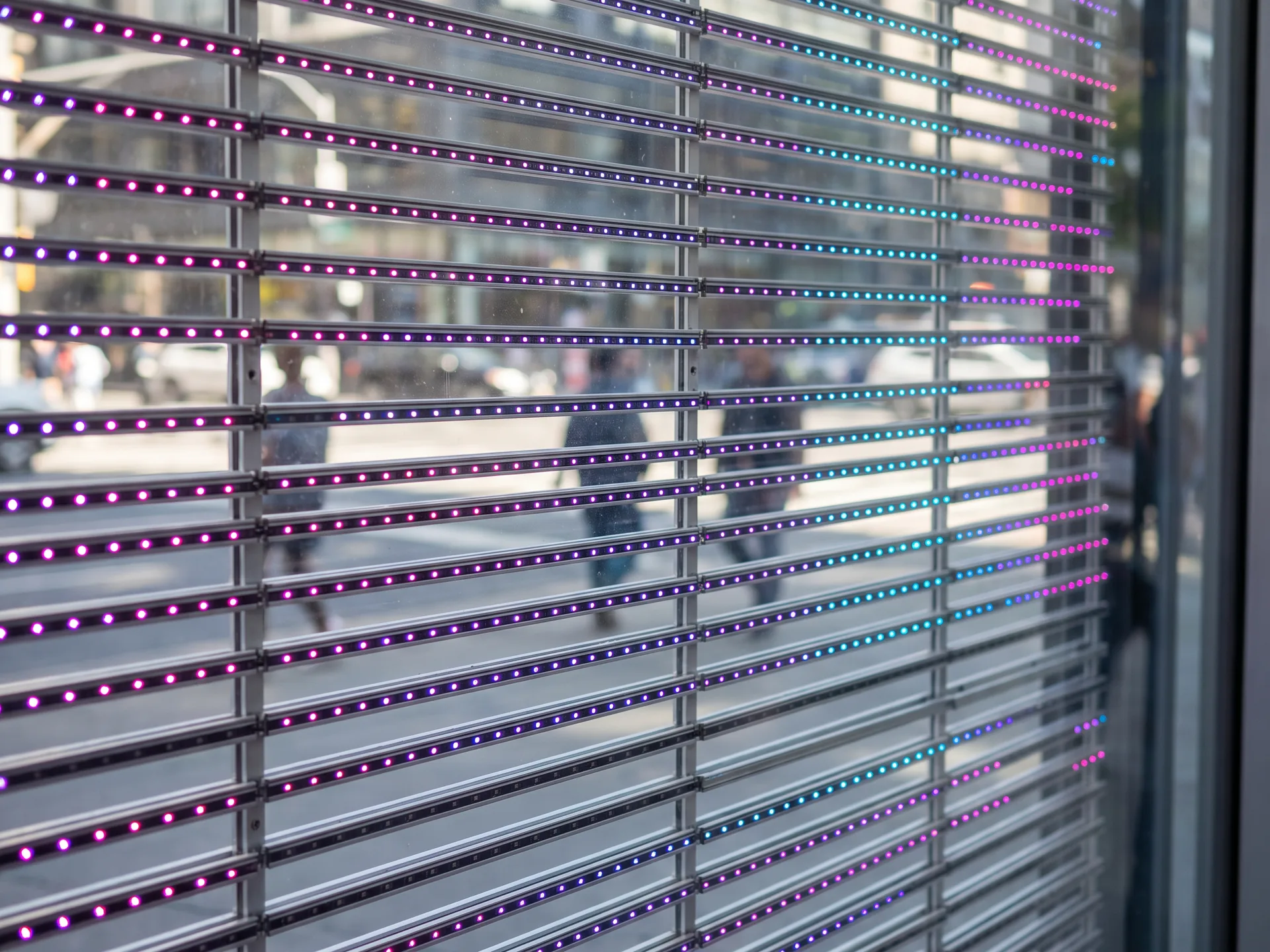
On a solid panel, the diodes cover the whole surface. On a transparent one, they sit on slim strips spaced a few centimetres apart, and between two strips there is simply nothing. Light passes through, and so does the eye.
That empty space is measured: it is the transparency ratio, the share of the surface that stays see-through. Panels on the market run roughly from 50 to 90 %. And this is where the one trade-off that matters comes in:
The more transparent the panel, the fewer diodes it carries — so the coarser the image. Spacing the strips further apart to see through them means spacing the pixels further apart too. There is no panel that is both very transparent and very fine: a choice has to be made, and it is made according to what sits behind the glass.
This is also why a transparent panel should not be judged against an LED wall on definition alone. It is not playing the same game, and what it brings is not measured in pixels.
The first trade-off
Transparency ratio and pixel pitch: the decision table
Three families of settings cover very nearly every project. Start by looking at what there is to see behind the glass: that is what decides, long before the size of the screen.
| Transparency ratio | Usual pixel pitch | What you get |
|---|---|---|
| 50 to 60 % | P3.9 to P5 | The densest image, readable from four or five metres. The window stays see-through, but the grid of strips is noticeable and the view is clearly filtered. Keep this for rich visuals watched from fairly close. |
| 65 to 75 % | P6 to P10 | The usual balance for a shop window: the message carries a few metres and the goods behind stay plainly visible. A sensible starting point for most projects. |
| 80 to 90 % | P10 to P16 | The panel all but disappears: from outside, a glazed facade still reads as a glazed facade. The image is read from a distance, in simple blocks of colour and large shapes. This is the choice for facades and for height. |
These figures are market orders of magnitude, not EMITY specifications: every manufacturer splits its range differently, and the model’s datasheet is what counts. The reading rule, on the other hand, holds for any panel: the pitch in millimetres is roughly the minimum comfortable viewing distance in metres. A P10 is read from about ten metres — which, for a shop window on a pavement, already means the other side of the street.
The technologies
Four ways to make a screen see-through
The phrase « transparent screen » covers four rather different products, which are neither fitted nor maintained in the same way. Knowing which one is being quoted changes how you read the quotation.
LED strips
Bars of diodes one to two centimetres tall, clipped or bonded to the inner face of existing glazing. This is the most common family for a shop window: light, removable, fitted without touching the glass, and repairable one strip at a time.
The usual case
Adhesive LED film
A flexible film a few millimetres thick, bonded straight onto the glass. The most discreet and the lightest of all, at the cost of the coarsest definition and a more modest brightness. It suits simple messages, shapes and slow animation.
The lightest
LED mesh or grid
A self-supporting frame of tubes or mesh, designed for large surfaces and facades. The gaps are wide: wind passes through the structure instead of pushing against it, which lightens the structural study considerably compared with a solid panel of the same size.
Facades and large formats
LED glass
The diodes are laminated into the glazing itself. Nothing is added onto the glass, so nothing shows when the screen is off: this is the cleanest result. In exchange, it is decided when the building is designed, not afterwards.
New build and major refurbishment
The benefits
Nine reasons to choose a transparent panel
The first two are well known. The next seven tend to surface halfway through a project, although they weigh just as much on the decision — and sometimes more on the budget.
The shop window stays a shop window
A solid panel turns glazing into a wall: the goods, the depth of the shop and the light at the back all vanish behind it.
A transparent panel adds the message without removing the view. A passer-by reads the screen and sees what is behind it, in the same glance.
Daylight keeps coming in
This is the first objection architects and staff raise: nobody wants to work behind an opaque panel.
The gaps let most of the natural light through. The inside does not turn into a black box, and the artificial lighting has nothing to make up for.
Light enough for existing glazing
Reckon on the order of 10 to 15 kg per square metre, against 25 to 45 kg for a solid panel — a market order of magnitude, to be confirmed on the model’s datasheet.
Fitting is usually done on the glazing already in place, with no load-bearing structure and no building work.
Fitted inside, therefore protected
The screen is fixed on the inner face and broadcasts towards the street through the glass. It is therefore out of the rain, out of the frost and out of reach of vandalism.
The direct consequence: no weatherproof cabinet to pay for, and maintenance carried out indoors, with no cherry picker and no work at height.
Wind passes straight through
High up or on a glazed roof, a solid panel behaves like a sail: wind load then governs the whole structural study.
The gaps in a transparent panel cut that load sharply. Formats and heights that a solid panel would make unreasonable become possible again.
Fewer diodes, less power
For the same surface, a transparent panel carries far fewer diodes than a solid one: consumption per square metre reflects that.
The black background the technology imposes pushes the same way — an unlit pixel draws nothing. A design constraint that shows up on the bill.
An image that seems to float
Because black is not displayed but seen through, a visual built on a black background appears suspended in the glass, with no frame and no visible support.
That effect, far more than the definition, is what makes the technique worth it in a shop window and in stage design.
Formats a solid panel cannot do
A long banner above a bay, a vertical column between two mullions, a cylinder around a post: the panel is assembled module by module.
It follows the geometry of the glazing rather than imposing its own — curves included, which a conventional screen enclosure rules out.
Reversible, so removable
Nothing is sealed in: a strip-based screen can be taken down and refitted elsewhere, even after a single season.
For leased premises, a temporary campaign or an exhibition stand, that changes the arithmetic — and simplifies the schedule of condition.
The rule to know
On a transparent screen, black is the transparency
This is the point that sinks half of all installations, and it fits in one sentence: an unlit pixel displays nothing, it lets you see through. A visual designed for a conventional screen therefore produces the exact opposite of the intended result.
What works
Do this every time
- ✓A pure black background, never white and never grey: a dark grey already lights every diode and lays a milky veil over the window.
- ✓Bright, saturated blocks of colour, which hold up against daylight.
- ✓Heavy type and few words: the grid is wide, and thin letterforms are lost in it.
- ✓Cut-out shapes, silhouettes and outlines rather than a full photograph.
- ✓Slow, broad animation: a passer-by looks for two seconds.
- ✓The exact format of the panel, often very elongated, set from the moment the visual is created.
What ruins the effect
Avoid this
- ✗A white or light background, which switches off the transparency and turns the screen into an illuminated sign — the exact opposite of what was bought.
- ✗A full-surface photograph: the subject reads poorly through the grid, and the real scene behind shows through the image.
- ✗Small type, paragraphs, legal notices, a price list at the bottom.
- ✗Dark gradients, which turn into a dirty grey veil instead of disappearing.
- ✗A logo sitting on a white block: it needs cutting out on black.
- ✗Backlighting: a dark visual in front of a brightly lit interior simply disappears.
An honest choice
Where transparent wins… and where it has no business being
A transparent screen in the wrong place costs more than a conventional one and displays less well. Better said before the quotation: here are the two lists.
The right ground
Where the view is worth something
- ✓A shop window whose goods must stay visible.
- ✓A glazed roof or facade, where daylight and the view matter as much as the message.
- ✓A foyer or atrium, to inform without partitioning the space.
- ✓A showroom, where the product on display stays the star.
- ✓An exhibition stand, put up and taken down within a few days.
- ✓A stage set, when the scenery has to stay readable behind the image.
The wrong ground
Where a conventional screen wins
- ✗A solid wall: nothing to see behind, so nothing to gain. A solid panel costs less and displays better.
- ✗A fine image viewed close up: at two metres, the grid can be counted by eye.
- ✗Dense text: detailed opening hours, menus, prices, terms. A conventional screen does that without effort.
- ✗A dark room where contrast has to be at its highest: see-through black becomes a fault there.
- ✗A brightly lit background right behind the screen, which washes the image out.
- ✗A tight budget per square metre: transparency is paid for, and it only pays back if the view is worth something.
In situ
Four places where transparency changes something
What these four have in common is not the sector: it is that behind the glass there is something worth keeping in view.


Each of these has its own page: digital window displays for the high street, the E-MANAGER platform for a whole estate of screens, and live scoring for venues that need results in real time.
The comparison
Transparent, solid LED wall or window display?
All three answer « put something in a window », but not the same need. Eight criteria are enough to decide — and the last one is worth noting: the choice of hardware does not dictate the software.
| Criterion | Transparent screen | Solid LED wall | LCD window display |
|---|---|---|---|
| The view behind the screen | Kept: 50 to 90 % of the surface stays see-through | None: the panel blocks the glazing | None: the enclosure is opaque |
| Definition | Coarse by design: P3.9 to P16 | Can be fine, down to P0.9 indoors | Native, 4K common from 55 to 86 inches |
| Readability close up | Poor: the grid shows from a few metres | Good as soon as the pitch is fine | Excellent at any distance |
| Format | Free, module by module, curves included | Free, module by module | Fixed by the catalogue |
| Weight per square metre | 10 to 15 kg | 25 to 45 kg | Concentrated on a few fixing points |
| Fitting | Onto existing glazing, from the inside | Load-bearing structure and structural study | Ventilated enclosure, recessed or free-standing |
| Content it expects | Bright blocks on black, few words | Any kind of visual | Any kind of visual |
| Driven with EMITY | Identical: same platform, same playlists | Identical | Identical |
In practice the question comes down to the value of whatever sits behind the glass. If it deserves to be seen, transparent wins. If not, a solid LED wall displays better for less, and a digital window display is ample below a few square metres. Our range of professional screens covers that last case.
Before you order
The eight points to check before signing
None of them is expensive to deal with up front. All of them become so once the screen is fitted.
How far away the first viewer stands
Measure where the person reading will be, not the area of the wall. The pitch in millimetres gives roughly the minimum distance in metres: going finer than necessary makes the panel dearer and closes the view for nothing.
What there is to see behind
A window packed with goods tolerates less grid than a bay opening onto a garden. That is what sets the useful transparency ratio — and therefore the pitch.
Brightness behind glass
Glazing reflects the sky. Reckon on an order of 2,500 to 5,000 nits for a south-facing window, and plan an ambient light sensor to bring the intensity down at night.
Which way it reads
A screen fitted inside and read from the street has to face the street. A front panel mounted the wrong way round gives a mirrored image from the pavement: check this before fitting, not after.
Fixing and glazing
Bonded, clipped, suspended or framed: the fixing method and the load are validated with whoever fitted the glazing, particularly on double glazing or laminated glass.
Access for maintenance
A strip is replaced one at a time, provided it can be reached. A six-metre-high screen with no access planned turns every fault into a cherry-picker job.
Power and cabling
On glazing, everything shows. Cable routes, the position of the power supplies and of the player are drawn at the design stage, not on the day of installation.
The exact resolution
It matches no standard format. A four-metre by 60 cm band at a 7.8 mm pitch works out at 512 × 77 pixels: that value, and no other, is what goes into the signage software.
The EMITY answer
Driving a transparent screen: what changes from one platform to another
The panel is chosen, fitted and powered. What remains is sending it something — at the right size, at the right moment, and on the right background.
Works with every manufacturer
A software house tied to a hardware brand only drives that brand’s screens. EMITY supports every manufacturer: one platform whatever the hardware, transparent panels included.
A window already fitted out is taken over without changing a single strip, even if it currently runs on a competitor’s software — the list of supported equipment is public.
The exact format, however odd
This is the difficulty specific to transparent panels: a four-metre by 60 cm panel at a 7.8 mm pitch is 512 × 77 pixels. That format is nobody’s standard.
In E-MANAGER the resolution is entered in the playlist’s broadcast settings: the visual then arrives with no distortion, no cropping and no black bars.
Designing the visual on black
EMITY’s built-in editor opens a canvas at the size of the panel, black background included, and the template is reused from one message to the next. Nothing to export, no extra account.
If your teams already use them, the Canva and Adobe Express bridges hand the media back at the right size.
Schedule it rather than watch it
Broadcast slots are prepared in advance, day by day and screen by screen. A shop window can therefore keep running after closing time, then switch off at the appointed hour.
For an advertising screen in a public place, the legal framework is set out on our DOOH screens page.
A player, only where it earns its place
A transparent panel receives its signal through a dedicated processor. Upstream, an E-BOX player feeds it a steady stream, animation included.
On screens described as all in one, E-SOFT installs straight into the screen’s own memory: no box to power. Both routes coexist across one estate.
A suite, not one more piece of software
The window is often only the start. The same platform then runs the whole estate, and covers queue management, room booking, the visitor register and sports scoring.
One contract, one training session, one point of contact as needs change — the subscription plans cover the lot.
Frequently asked
Your questions about transparent screens
More answers about digital signage are waiting in our signage FAQ, and the detail of LED panels on the LED screen page.
A shop window worth talking about?
Three months of trial on the full version, up to three screens, with no commitment and no card details. You can build the visual at the exact format of your panel before it is even fitted — and if the project needs a survey, we will put you in touch with the right integrator.


