
Customer case · Food to go
Digital signage in kiosks and concessions:
the Sushi Daily case
Sixty screens across eleven countries, fitted in supermarkets, railway stations and airports — in outlets where the brand owns neither the walls nor the network. Here is how a concession a few dozen centimetres wide is run from a desk.
The rollout
Sixty screens, eleven countries, not one wall of its own

Sushi Daily
Food to go · kiosks and concessions
Supermarkets, stations, airports — Europe
Fitted by EMITY
Sushi Daily makes sushi by hand, every day and in front of the customer, from kiosks and concessions fitted inside supermarkets, railway stations and airports across Europe. Its Sushi Experts are trained on more than a hundred recipes, and the brand serves in the order of a thousand meals a day.
What every one of those outlets has in common: the brand is a guest there. It owns neither the walls, nor the network, nor a technical team on site. That constraint is what shaped the rollout — sixty screens run from E-MANAGER, the dashboard that opens in a browser.
60
screens connected across the network
11
countries run from a single account
3
kinds of location: supermarket, station, airport
1
platform, and no travel to change a piece of content
The starting constraint
What changes when the outlet belongs to somebody else
Most chains fit out their own shops. Sushi Daily fits out space it occupies: a constraint of room, of network and of distance, before it is a question of signage.
The fit-out
Two building blocks: the software, and the screen
The rest — how the screen connects, the size of the panel, where it sits in the cabinet — is settled during the site visit, outlet by outlet.
On the ground
What the photograph of the rollout shows
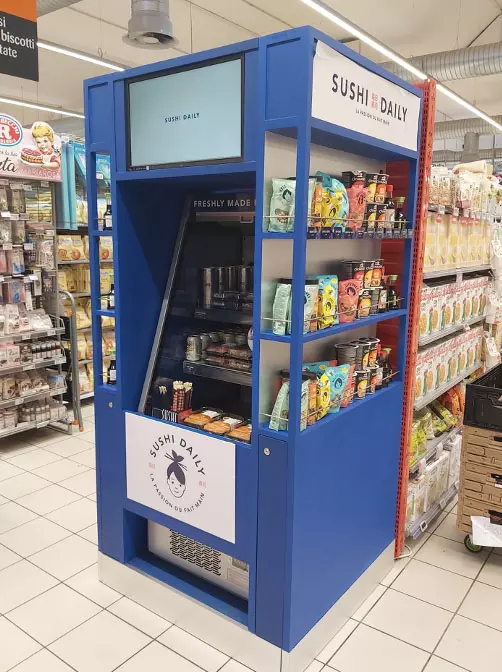
The concession as it was actually fitted
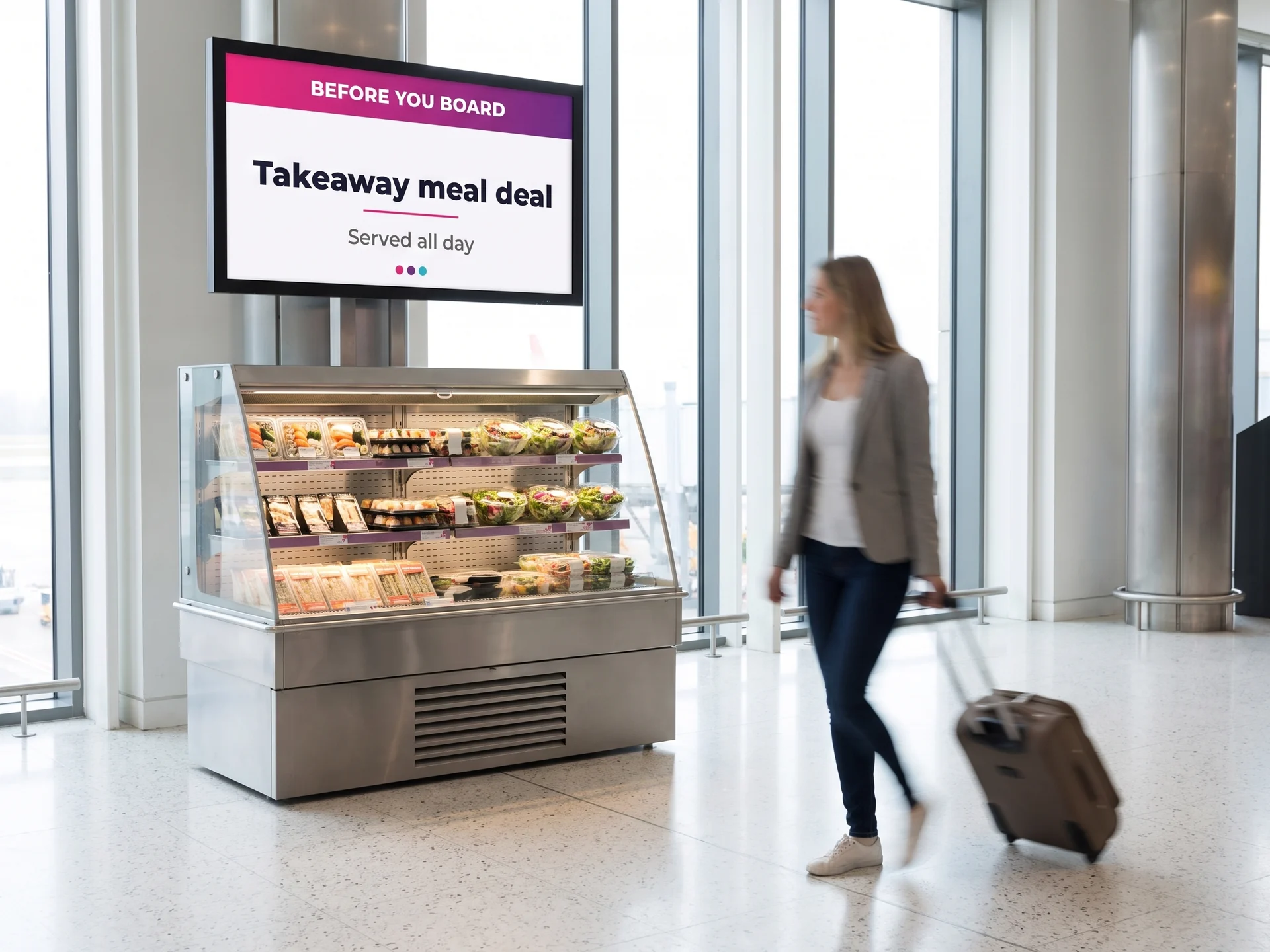
This is not a staged shot: it is a Sushi Daily concession in a supermarket aisle, as deployed. The unit takes up about the footprint of an end-of-aisle display, sitting among the host store’s own products. The screen is built into the top of the unit, above the chilled cabinet — the only part of the fitting visible from down the aisle.
That is also what explains the format. A screen mounted lower would be hidden by the customers stopping at the cabinet; a screen mounted higher would fall outside the envelope the store allows.
- ✓One screen per unit, built into the cabinet rather than bolted on beside it
- ✓A mounting height agreed with the host store
- ✓A single cable coming out of the unit
- ✓The same content as the kiosks, in a format that fits
Four contexts
One estate, four ways of being looked at
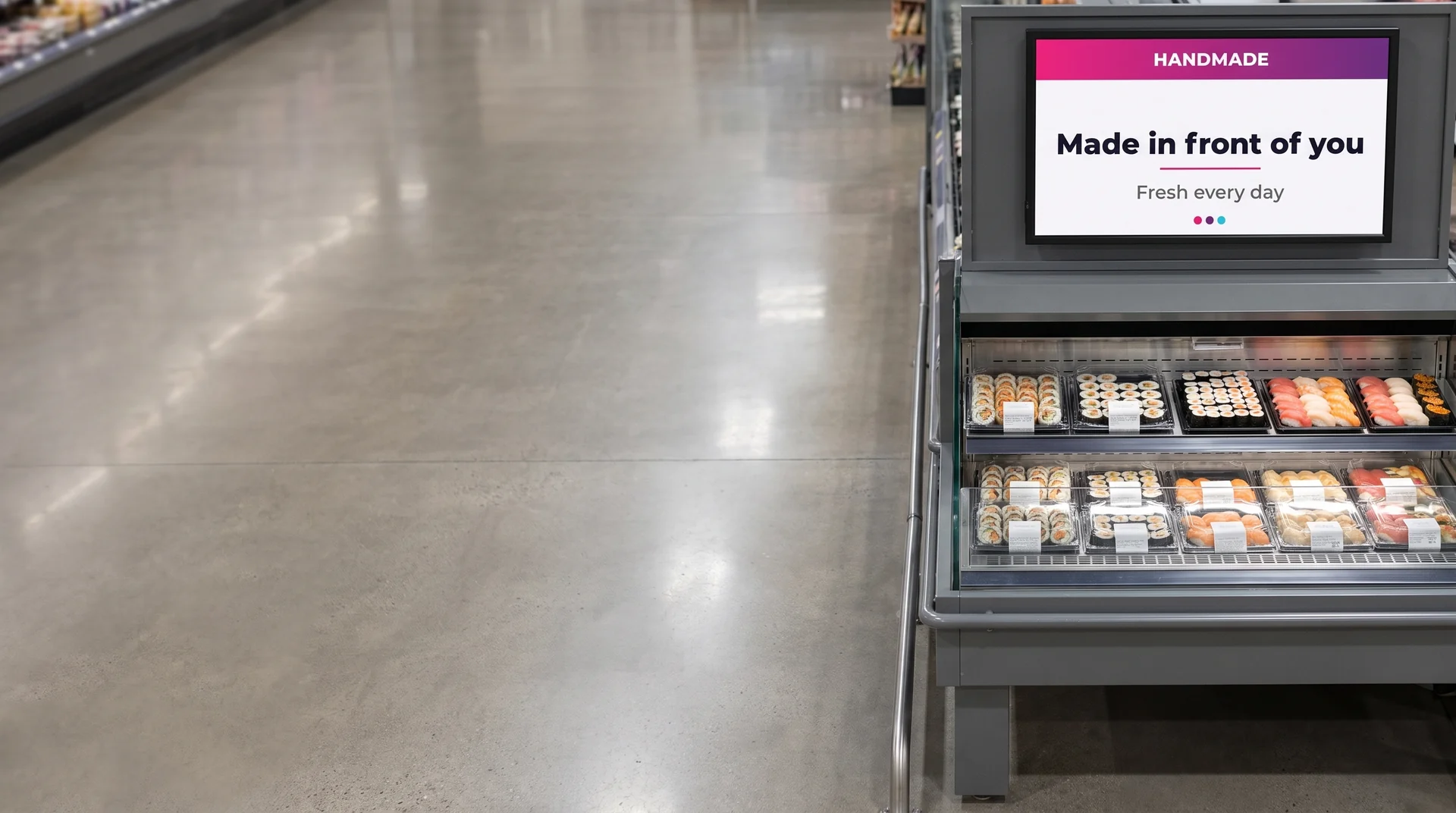
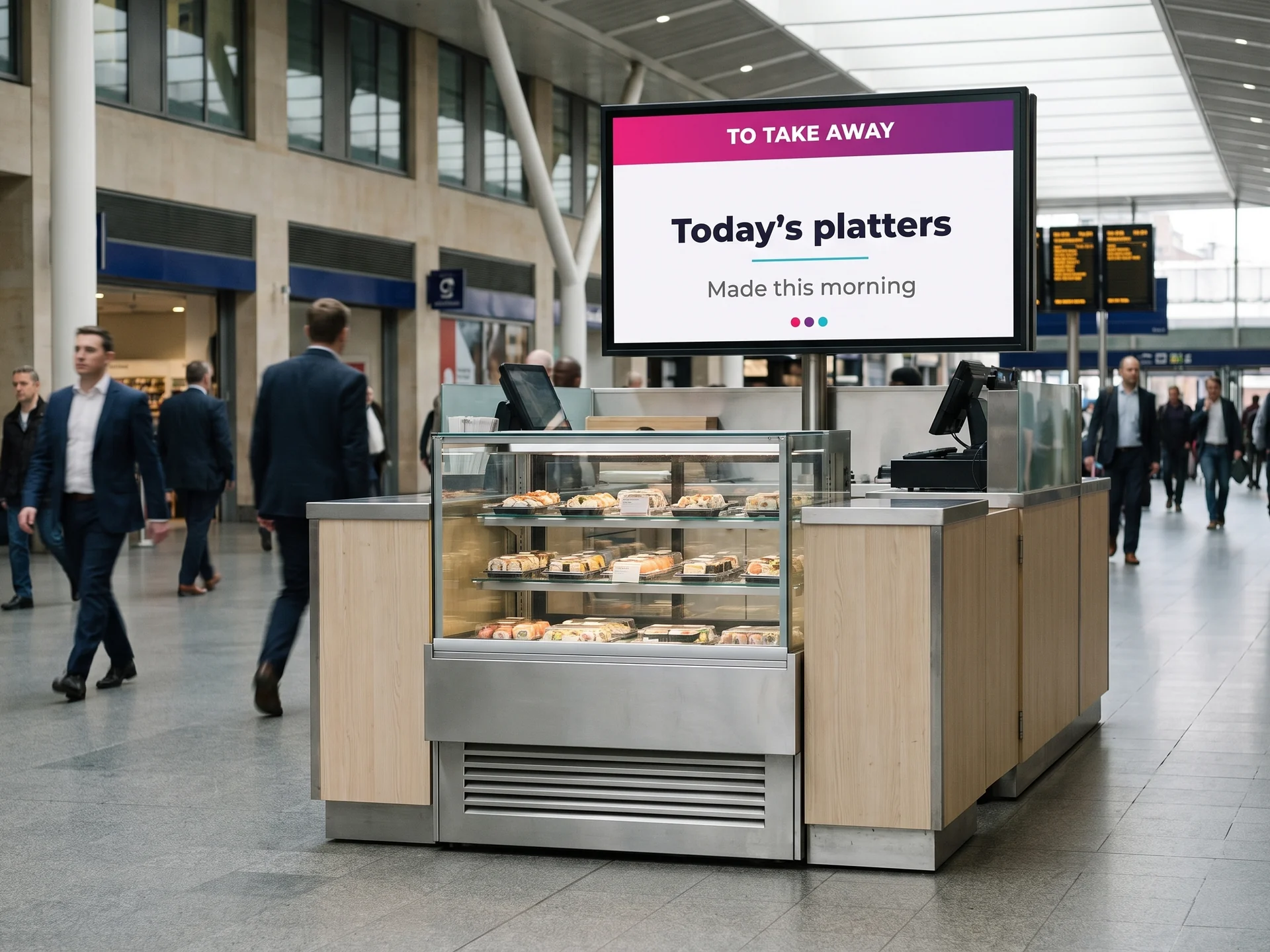
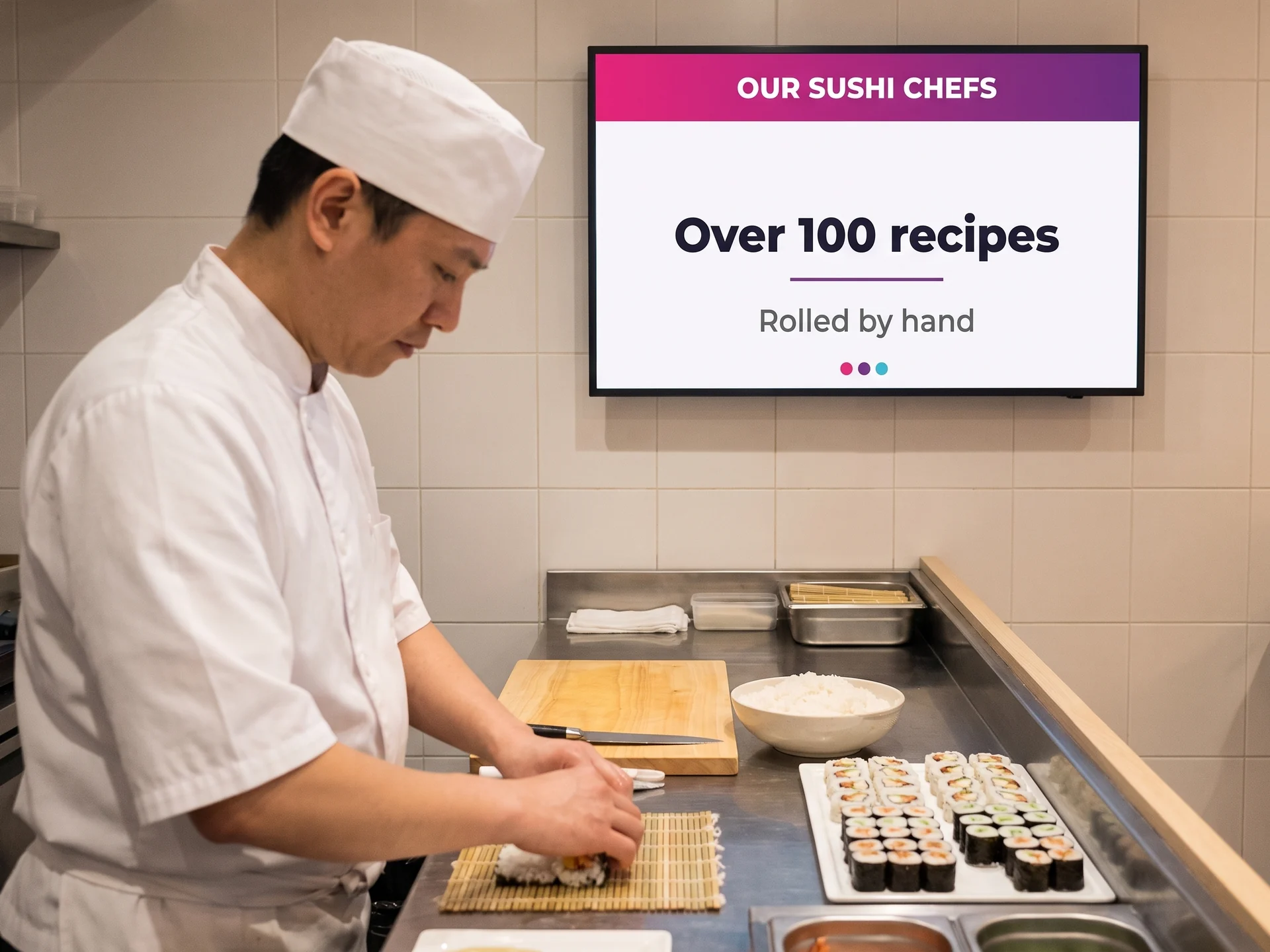
A concession screen, a station screen and a counter screen are not read in the same conditions. The location decides how long a message stays up and how many words it can carry.
Day to day
What the team actually gains
The benefit is counted in journeys avoided and in messages that land on the day they matter.
Video shows what a poster cannot say
Handmade proves itself in movement: the hands, the rice, the blade. A photograph freezes the result; video shows the making — and it keeps running while the Sushi Expert is busy serving.
One piece of content reaches eleven countries at once
Screens are grouped by country and by kind of location. A new line is pushed to a whole group, while each country keeps hold of what is its own — a local offer, a language, a public holiday that does not fall on the same day.
An offer changes without a train ticket
This is the point the team makes: communicating more often, without travelling. Across sixty outlets spread over a continent, every poster change avoided is one round trip fewer.
The screen goes inside the cabinet
The format is chosen to suit the room available in the unit, not the other way round. That is what lets a compact concession and a station kiosk be fitted from the same platform, with the same content.
In the client’s words
“It is simple to use, it meets our needs and all of our criteria comfortably.”
“We communicate about the brand and our products, and put out offers more often, without needing to travel.”
The questions that come up
What concession networks ask before fitting screens
Read on


