
Ovalt case study: ten screens linking four industrial sites
Ovalt — formerly Altenov — designs and automates production lines for the food industry. Nine subsidiaries, four sites, France and Morocco: getting the same information to everyone took more than a chain of emails.

The client
A Brittany-based group serving production lines
Ovalt designs, automates and optimises production processes for the food industry. The group also works in energy recovery, waste treatment and industrial infrastructure.
Founded in 1975 as OET and later renamed Altenov, it took the name Ovalt on 1 January 2022. Its head office is in Betton, near Rennes. One distinctive feature: more than half of the share capital is held by employees.
At the time of the rollout the group brought together nine subsidiaries across four industrial sites — Betton, Lamballe, Plumelin and Casablanca. It has kept growing since: Ovalt joined the CEME group in February 2026.
Figures and locations taken from the group’s own website and from the regional business press (January 2022). They describe Ovalt as it stood at the time of the rollout.
The starting point
When information never reaches the shop floor
In an industrial group, internal communication runs into a simple fact: a large part of the workforce does not sit in front of a computer.
Teams with no mailbox
On the shop floor, nobody checks an inbox between production runs. Information travelled on paper notices and by word of mouth — with the delay that implies.
Nine subsidiaries, nine rhythms
Each subsidiary has its own trade, its own customers and its own calendar. Nothing guaranteed that the same news reached Betton and Casablanca at the same moment.
Instructions that have to be seen
Protective equipment, a planned line stoppage, a customer visit: messages that lose their point the moment they arrive late.
The rollout
Ten screens, one platform
The rollout comes down to four steps, and none of them asks anything technical of the customer.
The screens
Ten screens across the sites, placed where teams walk past every day: reception, the shop floor and the canteen.
The link
Each screen connects to E-MANAGER, either through the E-SOFT app installed inside a professional display, or through an E-BOX player.
The content
EMITY’s built-in editor puts together notices, instructions and news inside the platform itself. Widgets add the time, the weather or a news feed.
The scheduling
Every item carries its own dates and times. The message goes out when it should, and clears itself once it no longer applies.
“We chose EMITY because we wanted to be able to schedule the distribution of information”
Céline Amary, communications manager at Ovalt
On site
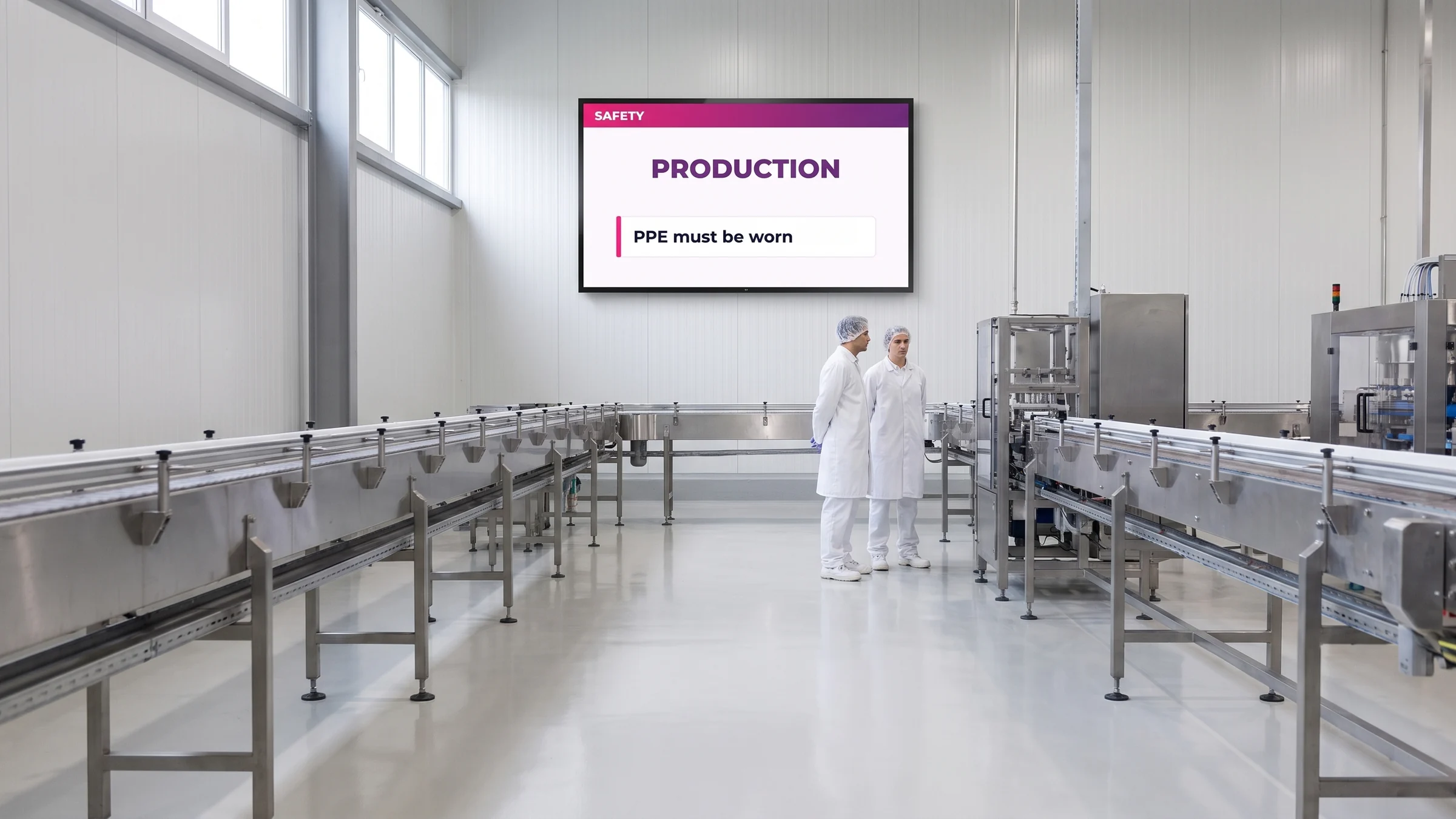
Three places where a screen makes a difference
A screen is only worth having where somebody actually looks at it. These are the three spots that come up on an industrial site, and what each one brings.


Running it
Create once, publish everywhere
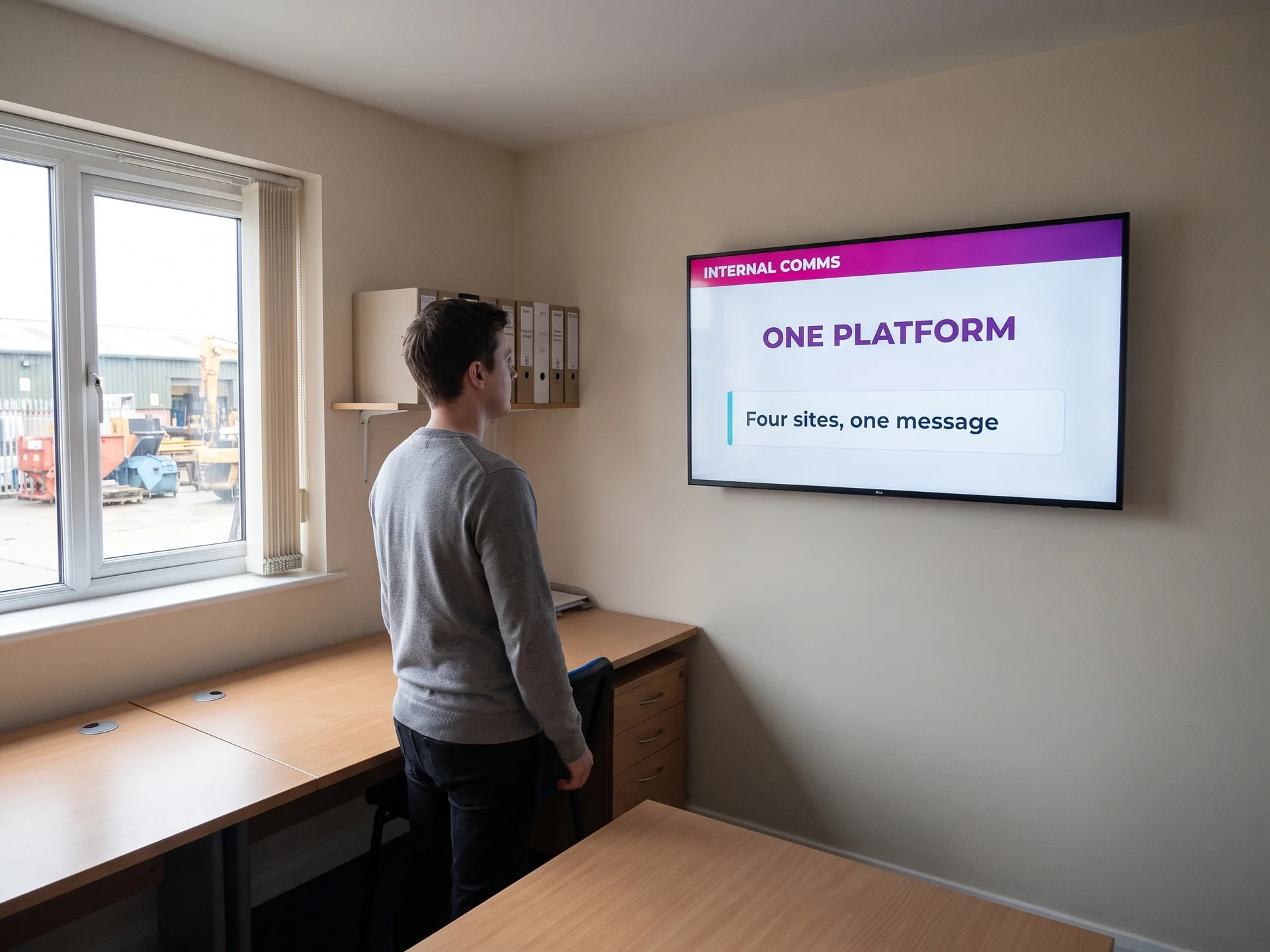
From E-MANAGER, the communications manager puts the item together, chooses which screens receive it and sets the publication window. A safety notice goes to the shop-floor screens only; group news goes to all ten.
- ✓One item created once, shown on as many screens as needed
- ✓Dates and times set in advance, including for a site in another country
- ✓A preview of the result before anything reaches a screen
- ✓The status of every screen visible from the dashboard
“The scheduling system is very practical”
Céline Amary, communications manager at Ovalt
Why EMITY
What matters when screens are spread across several sites
A multi-site rollout raises different questions from a single screen. Three of them come up every time.
Works with the screens already there
EMITY runs with every manufacturer. A mixed estate, inherited from several subsidiaries, does not force a full replacement.
One contract, one point of contact
From 1 to 1,000 screens per account: the same platform, the same training and the same contact, whatever the number of sites.
One suite, several jobs
Beyond signage, the same platform handles the visitor book, room booking and queue management.
+7,000
connected screens
+1,000
customer accounts
+20
countries
Frequently asked questions
Digital signage on an industrial site
Would your sites gain from showing the same information?
We look at your locations, the screens you already have and what you want to show. The demo runs on your own content. You can also browse our other case studies or the E-MANAGER platform.


