Radioshop · EMITY

In-store music:
your own shop radio, in step with your screens

An offer appears on the screen, and the same announcement goes out over the loudspeakers at that very moment. Radioshop composes the tailor-made radio for your shop, EMITY drives what it displays: your customers receive one message, through two senses at once.

1 monthtrial of the radio, no commitment
6 daysa week of support, in three languages
+7,000screens connected to EMITY
+1,000EMITY customer accounts

The partner

Who is Radioshop?

Radioshop is a French specialist in in-store music. Its trade: composing an in-store radio for a retail brand — a radio played inside your own walls, where you decide the music, the announcements and the pace.

Logo Radioshop, EMITY's music and digital signage partner

A neighbour of ours

Radioshop is based in Saint-Jean-de-Védas, in the Hérault, some twenty kilometres from EMITY’s head office in Jacou. Two software houses from the same corner of southern France, which makes joint projects a good deal simpler to organise.

  • 20 years in the sound of retail spaces
  • 20,000 outlets equipped worldwide
  • More than 400 brands supported
  • Retail, hospitality, health and wellbeing, sport and leisure, offices

Figures published by Radioshop on radioshop.fr, checked on 15 August 2026.

The principle

The same message, seen and heard

A screen only reaches the people looking at it. Sound reaches everyone — including the shopper whose back is turned, hands deep in a display. The two do not speak to the same audience at the same moment, and that is precisely why they work well together.

Screen mounted above the fruit and vegetable aisle of a supermarket, with a ceiling loudspeaker visible

What setting it to music changes

A promotion carried on both channels does not take twice the work. It takes deciding once what is being said, then sending it to the screen and to the airwaves.

  • The on-screen announcement is echoed out loud, at the moment it appears
  • The shopper who never looks up still receives the information
  • The silence of a quiet shop is filled with chosen music, rather than a general-interest station
  • Your teams gain a channel of their own, before opening or after closing

The screen shows

An offer, a visual, an opening time, a menu: whatever reads better than it sounds goes to the screen, where a customer can come back to it.

The radio announces

Whatever has to reach everyone, including well outside the screen’s line of sight, goes through sound. A message lasts seconds and covers the whole floor.

You set them both

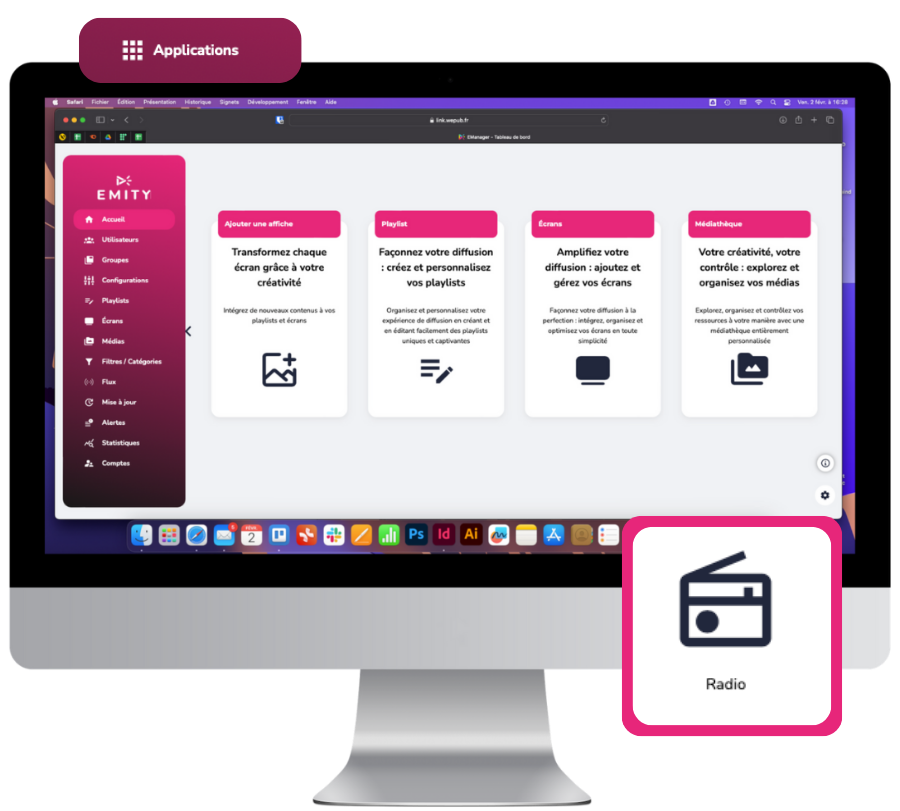
Screens are programmed in E-MANAGER, the radio in the Radioshop interface. Two tools, one campaign, the same calendar.

In-store radio

A radio composed for your brand, not a playlist picked at random

Tuning an FM station costs less — and plays your competitors’ advertising between two songs. A shop radio turns that round: the programme is written for your customers, and the only brand heard on it is yours.

What Radioshop composes

  • Playlists matched to your customer profile, refreshed every day
  • One advertiser only: you — never another brand’s spot
  • Group-wide messages and outlet-specific ones, on the same station
  • A music catalogue of several hundred thousand tracks
  • An atmosphere designed for your customers… and for the staff who hear it all day

Source: the Radioshop & EMITY brochure, read on 15 August 2026.

Portrait screen on the wall of a hotel lounge bar announcing the evening, with a wall loudspeaker above it

The announcements

A studio writes, records and produces your messages

Recording an announcement from a mobile does the job in a pinch, and Radioshop allows it. For anything that stays on air for weeks, the brand goes through the studio — and it can be heard.

Wall-mounted screen announcing group classes on a fitness club floor, with a loudspeaker fixed to the wall

Four families of message

  • Commercial — an offer, a seasonal peak, a new arrival
  • Goodwill — a welcome, a holiday greeting, a thank you
  • Service — what the shop does for its customers
  • Staff motivation — keeping teams informed and service quality up

And for the urgent ones: a message recorded on a phone goes out shortly afterwards, on the outlets you choose.

1

Writing

Copywriters draft the message from your brief.

2

Recording

The script is recorded by the voice you pick from a casting list.

3

Production

Producers and sound designers dress the message in your brand’s sound.

4

Playout

The message is scheduled from your interface, on the outlets you choose.

Getting started

What installation actually takes

This is the question that stalls a multi-site project more often than any other: how long per shop, and who has to travel. The answer comes in two parts — a few minutes, and nobody.

On the IT side

  • A non-streaming system: bandwidth use stays very low
  • A time window and a bandwidth cap can both be set
  • Works over VPN and MPLS networks
  • DHCP, or a full IP configuration — mask, gateway, primary and secondary DNS
  • A software-only option exists where a machine is already in place, instead of the player

Source: the Radioshop & EMITY brochure, read on 15 August 2026.

Black media player box wired to an audio amplifier on a shelf, below a wall screen showing a message to the team
1

The kit arrives

Radioshop ships the player and its cables to each outlet, on hire or for purchase.

2

A phone appointment

The technical team rings the shop: player set beside the sound system, network cable, audio cable to the amplifier, power, volume set.

3

The radio plays

A few minutes later it is on air. No site visit, no work on your servers.

Day to day

Running the radio, and knowing what the estate is doing

An estate of outlets raises two standing questions: which music and which messages are actually on air, and where playout has stopped. Both are read in the same place.

The management interface

  • Order and schedule your audio messages in a few clicks
  • See what has been played, day by day
  • Check the technical state of the estate at a glance

Radioshop support

  • A helpline Monday to Saturday and on bank holidays, 9 am to 6 pm, at standard call rates
  • Three languages: French, English, Spanish
  • Faulty kit replaced within 24 to 48 hours, on a swap basis
  • An automatic alert to the team as soon as a player drops off the network
  • A technical project manager per brand, and weekly operating reports

Source: the Radioshop & EMITY brochure, read on 15 August 2026.

What about music licensing?

It is the first question anyone asks before putting music into a public space, and it deserves a straight answer rather than silence.

  • Playing recorded music in a space open to the public needs a licence, wherever you are. It covers two separate rights: the composers and publishers, and the performers and record companies.
  • In the United Kingdom, that means PRS for Music and PPL — normally bought together as a single licence.
  • In France, the declaration goes to the Sacem, which also collects the equitable remuneration shared out by the SPRE.
  • A consumer streaming subscription does not cover this use: those services restrict listening to private settings in their terms.
  • It is therefore the first point to settle with Radioshop when setting up, since the fee depends on your floor area, your trade and your opening hours.

Sectors

Where screen and sound work together

Anywhere a place welcomes the public and already plays music, the screen has a twin channel waiting to be tuned to it. In-store music is not a retail-only idea: it applies wherever someone waits, wanders or settles in.

Retail and grocery

Aisle promotions, seasonal peaks, closing announcements: the screen displays, the radio announces. Shops →

Hotels and hospitality

Today’s menu, evening events, the services on offer: the sound is part of the stay. Hotels →

Sport and leisure

Class timetables, membership news, the tempo of the floor: music carries the effort as much as the information. Sport & fitness →

Banking and insurance

In branch, sound softens the wait while the screen sets out the products and services. Banking →

Frequently asked questions

What retailers ask before putting music into an outlet

Playing recorded music in a space open to the public needs a licence covering two separate rights: the composers and publishers, and the performers and record companies. In the United Kingdom that means PRS for Music and PPL, normally bought together. In France the declaration goes to the Sacem, which also collects the equitable remuneration shared out by the SPRE. The fee depends on your floor area, your trade and your opening hours — settle it with Radioshop when you set up.

No. Consumer subscriptions restrict listening to private settings in their terms: they are not a licence to play music in a shop, and they bring neither a programme written for your customers, nor announcements, nor multi-site control. A professional solution settles all three at once.

Radioshop composes the programme around your brand and your customer profile: a sports shop, a jeweller and a bakery call for neither the same repertoire nor the same tempo. The playlists are then refreshed every day, which avoids the looping effect that staff notice long before customers do.

Yes. The player is self-contained: preloaded at the factory, it plays from the moment it is switched on and carries on if the network drops. The system is also non-streaming, with a time window and a bandwidth cap that can both be set, so it sits very lightly on a shop’s line.

A few minutes, over the phone. The player and its cables are shipped to the shop, then the technical team talks the staff through the connections: power, network cable, audio cable to the amplifier, volume. No site visit is needed — which changes everything across an estate of several dozen outlets.

No: in-store radio works on its own, and so does digital signage. Bringing them together adds something else — one campaign carried by picture and by sound, on the same calendar. That is why the two companies work together.

The visual is composed in EMITY’s built-in editor and scheduled in E-MANAGER on the screens concerned; the audio message is ordered and scheduled in the Radioshop interface, on the same outlets and the same dates. The useful work is not technical: it is deciding once what is being said, then lining the two calendars up.

An FM station brings its own schedule, its presenters and above all its advertisers — your competitors among them, playing in your shop. A shop radio carries one advertiser only: you. The repertoire is chosen for your customers, and group messages sit alongside outlet messages on the same station.

Let people hear what your screens show

Tell us what your screens show today and what you would like people to hear: our teams will show you how the two line up, and Radioshop lets you try its radio for one month, with no commitment.